How to Travel With a Surfboard
The same board bag can fly free on one carrier and cost $200 return on another, and nothing about the ticket price tells you which. Airlines treat surfboards under a separate sports equipment policy with its own size ceiling, its own weight line, and aircraft specific caps that catch people out on the short connecting leg rather than the long haul. September is when this starts to matter, because northern hemisphere surfers are booking winter trips now and southern hemisphere spring travel is already moving. This guide collects what the carriers and fee trackers actually publish: the fee per airline, the dimension and weight limits behind those fees, and the packing sequence that keeps a board intact through a baggage system. Every figure below is linked to the page it came from, and every one of those pages loaded when it was checked.
Surfex is an aggregator. Every fee and limit here comes from an airline page or a published fee tracker linked in the sources section. Airlines change policies without notice, so confirm with your carrier before you book.
| Airline | Board bag charge | Published limits | Source |
|---|---|---|---|
| Alaska Airlines | Standard checked bag fee | Up to 50 lbs. Max 125 in length on 737 and Airbus aircraft, 115 in combined on flights 2000 to 3499 | Alaska Airlines |
| American Airlines | $50 first bag, $45 if paid online | Standard checked bag rules up to 50 lbs, sports equipment capped at 115 linear in | American Airlines, Lush Palm |
| Delta | Within your checked allowance | Over 50 lbs triggers overweight fees, 115 linear in ceiling, boards over 72 in refused on Delta Connection flights | Lush Palm |
| United | Standard checked bag fee | Up to 115 in on United, 92 in on United Express, oversize waived to and from California, overweight still charged | Stoke Riders |
| Southwest | Standard checked and overweight fees, oversize waived | Nothing over 100 lbs accepted, fins must be removed and carried separately | Lush Palm |
| Hawaiian Airlines | $30 inter island, $40 North America to Hawaii, each way | Max 125 in, standard weight limit 50 lbs, unlimited boards inside one bag | Lush Palm |
| Qantas | Free within your checked allowance | Max 32 kg and 277 cm, shorter limit of 240 cm on QantasLink Dash 8 aircraft | Lush Palm |
| Air New Zealand | Free under the limits, NZD $150 above them | Free under 6 ft 5 in and 50 lbs, oversize charges from 6 ft 5 in to 8 ft 2 in, 70 lb ceiling | Lush Palm |
| Garuda Indonesia | Free within your checked allowance | Max 50 lbs and 9 ft 8 in | Lush Palm |
Fees as published at the time of checking. Alaska and American figures come from the carriers, the rest from the Lush Palm and Stoke Riders trackers linked above.
Why your board bag is never a normal bag
Stoke Riders puts the whole system into two numbers: 62 linear inches and 50 pounds. That is the standard checked bag threshold on most U.S. carriers, and no board bag has ever come close to fitting inside it. The moment you pass it, your bag stops being luggage and becomes sports equipment.
That reclassification is good news more often than not. Sports equipment policies exist because skis, golf bags and surfboards would otherwise be rejected outright, so the ceiling rises to around 115 linear inches at the large U.S. carriers. The fee then depends on whether the airline treats the bag as a normal checked item or as a separately priced one.
Lush Palm makes the point that catches most people. Linear inches is length plus width plus height, not length. A packed shortboard bag measuring 79 by 24 by 12 already sits at 115, so a stated 115 inch allowance is roughly a 6 ft 5 in board, not a 9 ft 8 in one.
What the airlines currently charge
American publishes the clearest schedule. Across the U.S., Puerto Rico, the U.S. Virgin Islands, Canada, the Caribbean, Mexico, Central America and Guyana, the first checked bag is $50 or $45 online, and the second is $60 or $55 online, as updated on 18 May 2026. Basic Economy adds $5 to each.
Alaska keeps it simple by charging board bags the same as a standard checked bag, defining one item as a single case up to 50 lbs. Delta, Qantas and Garuda Indonesia carry boards inside your existing checked allowance, which is why they show up repeatedly in surf travel planning.
Hawaiian sits at the other end of the model, pricing per board bag each way, $30 between the islands and $40 between North America and Hawaii, but letting you fill the bag with as many boards as the weight limit allows. If you are hauling a quiver to one destination, per bag pricing beats per board pricing every time.
The connecting flight is where trips break
Mainline aircraft are generous. Regional aircraft are not, and surf itineraries almost always end on one. United allows 115 inches on its own metal but caps United Express at 92. Alaska allows 125 inches of length on 737 and Airbus aircraft, then drops to 115 inches of combined dimensions on flights numbered 2000 to 3499. Delta refuses boards over 72 inches on Delta Connection services entirely, which rules out almost every shortboard bag.
Check the aircraft on the last leg before you buy the ticket, not the first. A board that clears the transpacific sector and gets refused at the regional gate leaves you renting anyway, having already paid to fly your own boards halfway there. Trips to remote setups like the Mentawais and the Maldives almost always finish on a small aircraft or a boat transfer.
Packing so the board survives the belt
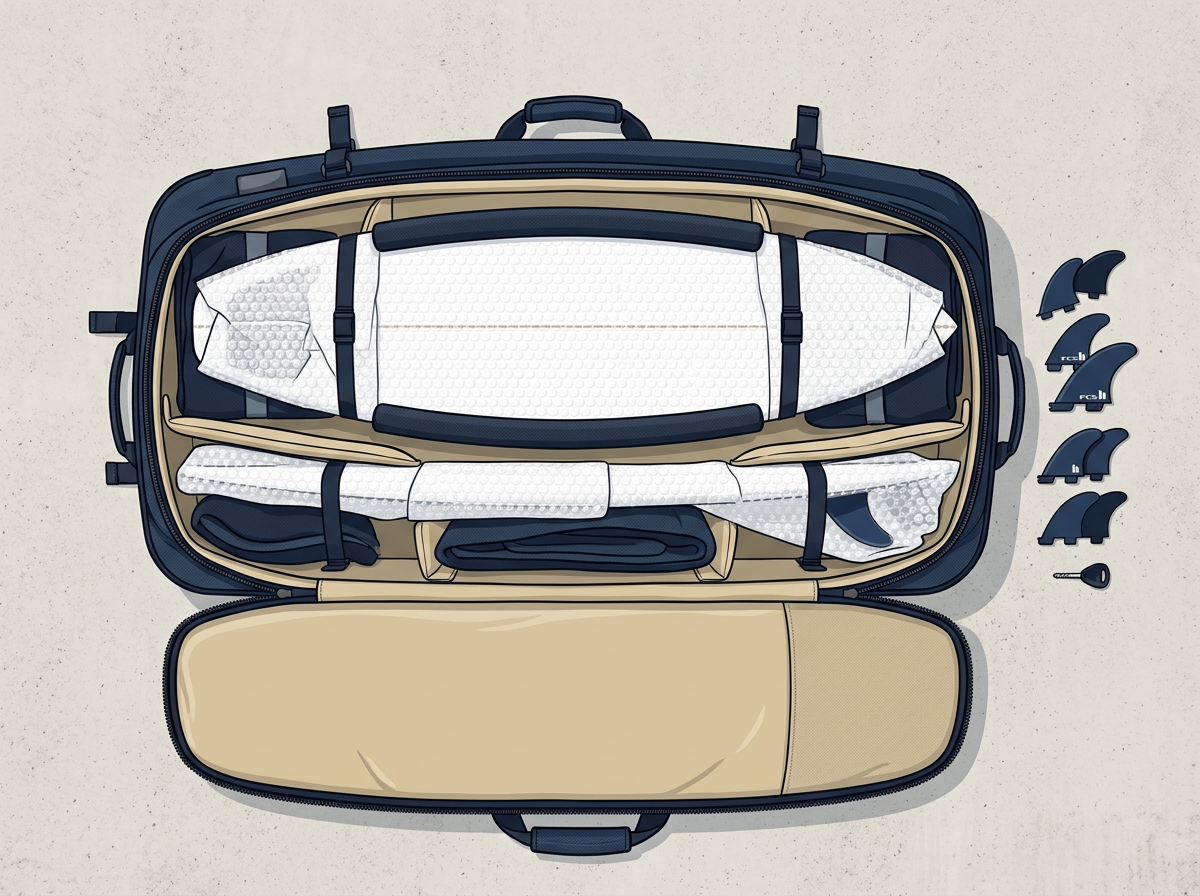
TAP Air Portugal publishes a packing document for exactly this, and its first instruction is about bag size rather than technique: buy a bag six inches, or 15 cm, longer than your longest board. That gap is what stands between a dropped bag and a cracked nose.
Fins come out next. Southwest requires keels and fins to be removed and carried separately, and the rule is worth following on every carrier, because a fin left in the box is a blade sitting against the deck of the board beside it. Pack them with the fin key in your carry on so a lost bag does not also cost you a fin set from your fin quiver.
Everything else is impact management. Build up padding at the nose and tail first, then use the wetsuit, towels and accessories as filler so nothing shifts in transit. A ding still happens sometimes, which is why a small repair kit belongs in the bag on any trip longer than a weekend.
Working out whether to fly boards at all
Do the arithmetic against the trip, not against the principle. Two American sectors at $50 each way is $200 before any overweight charge, which is close to a week of rental in most surf towns. On Delta or Qantas the same trip may cost nothing extra, and the calculation flips entirely.
Board choice matters more at some destinations than others. Somewhere like Nazaré or the North Shore rewards a shape you already trust, which usually means a step up you have surfed before. A beginner friendly point break with a rental rack at the end of the road does not justify the freight.
If you do fly, the bag itself is the variable you control. Weight, padding and length all come down to the choice covered in the travel bag guide, and a lighter bag buys you a couple of kilos of allowance before the overweight line.
Mistakes that cost money at the counter
- Reading a 115 inch allowance as board length rather than length plus width plus height.
- Checking the mainline aircraft rules and missing the regional cap on the final leg.
- Paying at the airport when the same bag is cheaper online, as with American at $45 against $50.
- Assuming an oversize waiver covers overweight as well. United and Southwest waive one and charge the other.
- Leaving fins in the boxes, then unpacking a punctured deck at the other end.
- Booking a codeshare and applying the marketing carrier's policy instead of the operating carrier's.
Sources
| Source | What it contributes |
|---|---|
| Alaska Airlines, Traveling with sports equipment | Official policy. One item of surfing or paddle equipment is defined as a surfboard or paddleboard case up to 50 lbs. On 737 or Airbus aircraft the equipment may measure a maximum 125 inches in length alone, while on flights numbered 2000 to 3499 the maximum combined dimensions may not exceed 115 inches. Cases over 50 lbs incur an overweight fee. |
| American Airlines, Checked bag fees and policies | Official fee schedule, updated 18 May 2026. Within and between the U.S., Puerto Rico, U.S. Virgin Islands, Canada, the Caribbean, Mexico, Central America and Guyana, the first checked bag is $50, or $45 paid online, and the second is $60, or $55 online. Basic Economy adds $5 to each. |
| Lush Palm, Surfboard Bag Fees 2026 | Fee roundup covering more than 35 airlines, updated 1 June 2026. Source for the Delta, Southwest, Hawaiian, Qantas, Air New Zealand and Garuda entries in the table on this page, and for the warning that linear inches means length plus width plus height rather than length alone. |
| Stoke Riders, Traveling With Surfboards, Kiteboards and Foils, Airline Rules 2026 | Explains the two numbers airlines actually apply, 62 linear inches and 50 pounds, and how the separate sports equipment policy raises that ceiling. Source for the United figures used here: board bags up to 115 linear inches, United Express capped at 92 inches, oversize fees waived to and from California, overweight fees still charged. |
| TAP Air Portugal, Practical Tips for packing a Surfboard for Transport by Air | Carrier published packing document. Recommends a heavy duty board bag sized six inches or 15 cm longer than your longest board, so the extra length absorbs impact rather than the nose and tail. |
Video guides

Related reading
FAQ
How much does it cost to fly with a surfboard?
It depends entirely on the carrier. Delta, Qantas and Garuda Indonesia count a board bag inside your normal checked allowance, so the marginal cost can be nothing. American charges its standard checked bag fee, which is $50 for the first bag or $45 paid online on most North American routes as of 18 May 2026. Hawaiian charges per board bag each way, $30 between the islands and $40 between North America and Hawaii. Air New Zealand is free under 6 ft 5 in and 50 lbs and NZD $150 above that.
What size surfboard can you take on a plane?
Most large carriers work to a 115 linear inch ceiling for sports equipment, which is length plus width plus height rather than length alone. Alaska publishes a more generous 125 inches of length on 737 and Airbus aircraft, and Qantas allows 277 cm. Regional aircraft are stricter: United Express caps board bags at 92 inches, Alaska drops to 115 inches combined on flights numbered 2000 to 3499, and Delta refuses boards over 72 inches on Delta Connection services.
Do I have to take the fins off my surfboard to fly?
Southwest states that keels and fins must be removed and placed in carry on or checked baggage. Other carriers do not require it, but every packing guide checked here recommends it anyway, because a fin left in the box is the sharpest object in the bag and it sits right against the next board.
Are surfboards charged as oversized or overweight baggage?
Both charges exist and they stack. Oversize is triggered by dimensions, overweight by the 50 lb line in economy. United waives the oversize fee on flights to and from California but still charges overweight, and Southwest waives oversize while keeping overweight. Splitting gear between the board bag and your other checked bag is usually cheaper than paying an overweight charge.
How many surfboards can go in one bag?
Alaska defines one item of surfing equipment as one case, and Lush Palm notes Alaska accepts up to two boards inside it. Hawaiian lets you pack as many boards as you want in one bag provided the bag stays within its 125 inch and weight limits. Air New Zealand also allows multiple boards inside the stated dimensions. The weight limit, not the board count, is what usually stops you.
Should I rent boards instead of flying with my own?
Run the numbers before booking. Two return sectors at $50 each way on American is $200 before overweight charges, which competes with a week of rental at most surf destinations. Flying your own quiver makes sense when the waves are specific enough that board choice matters, when you have a shape you cannot replace locally, or when the carrier carries boards inside your allowance.
The board you fly should match the wave you booked. The surf trip guides cover what each destination actually demands, the surfboard reviews collect scores gathered across retailers and editorial sources, and the accessories section covers the leashes, pads and repair kits worth taking with you.