Surf Gloves Guide
Numb hands end more autumn sessions than cold feet do. Gloves are also the one piece of neoprene where the warmest option is often the wrong one, because a glove that keeps your fingers toasty can also stop you feeling your rail or unclipping a leash. Water on most northern coastlines starts sliding through the fifties in September, which is the window where a 2mm or 3mm glove buys you another two months before winter kit becomes unavoidable. This guide gathers the published thickness bands, style definitions, sizing method and current listed prices from brand and retailer pages, all linked so you can check them.
Surfex is an aggregator. Every figure on this page comes from a published brand or retailer page linked in the sources section. Prices were read from those listings on the publication date and change without notice.
| Thickness | Water temperature | Where it fits |
|---|---|---|
| 1 – 2 mm | 60 – 50F / 15 – 10C | First glove of the season, thin enough that most surfers forget they have it on |
| 3 mm | High 55 – 45F / 13 – 7C | Pacific Northwest, Canada, spring and autumn on the central and north East Coast |
| 5 mm | 45 – 35F / 7 – 2C | North East, Alaska and the Great Lakes in early spring and late autumn |
| 7 mm | 40 – 30F / 4 – -1C | Full winter in the coldest surfable water, mostly sold as mittens |
Temperature bands published by Cleanline Surf.
Pick surf glove thickness by water temperature
Cleanline Surf publishes four clean bands. Gloves of 1mm to 2mm start making sense once water drops below 60F, 3mm covers the high fifties down to 45F, 5mm handles 45 to 35F, and 7mm exists for 40 to 30F water where sessions are measured in minutes.
Brand listings sit inside those bands rather than contradicting them. Xcel gives its 5mm Drylock five finger glove an ideal water temperature of 48F and below, which lands at the warm edge of the 5mm band. If you surf a coastline that spends most of the season in the fifties, a 3mm is the glove that will actually get used, and the 5mm is the one you keep in the car for the worst two months.
Cleanline also flags the variable people forget: wind chill and air temperature. A 50F offshore morning can justify a glove in water that felt fine last week. Treat the bands the same way you treat wetsuit thickness and adjust for how cold you run.
Five finger, lobster claw or mitten
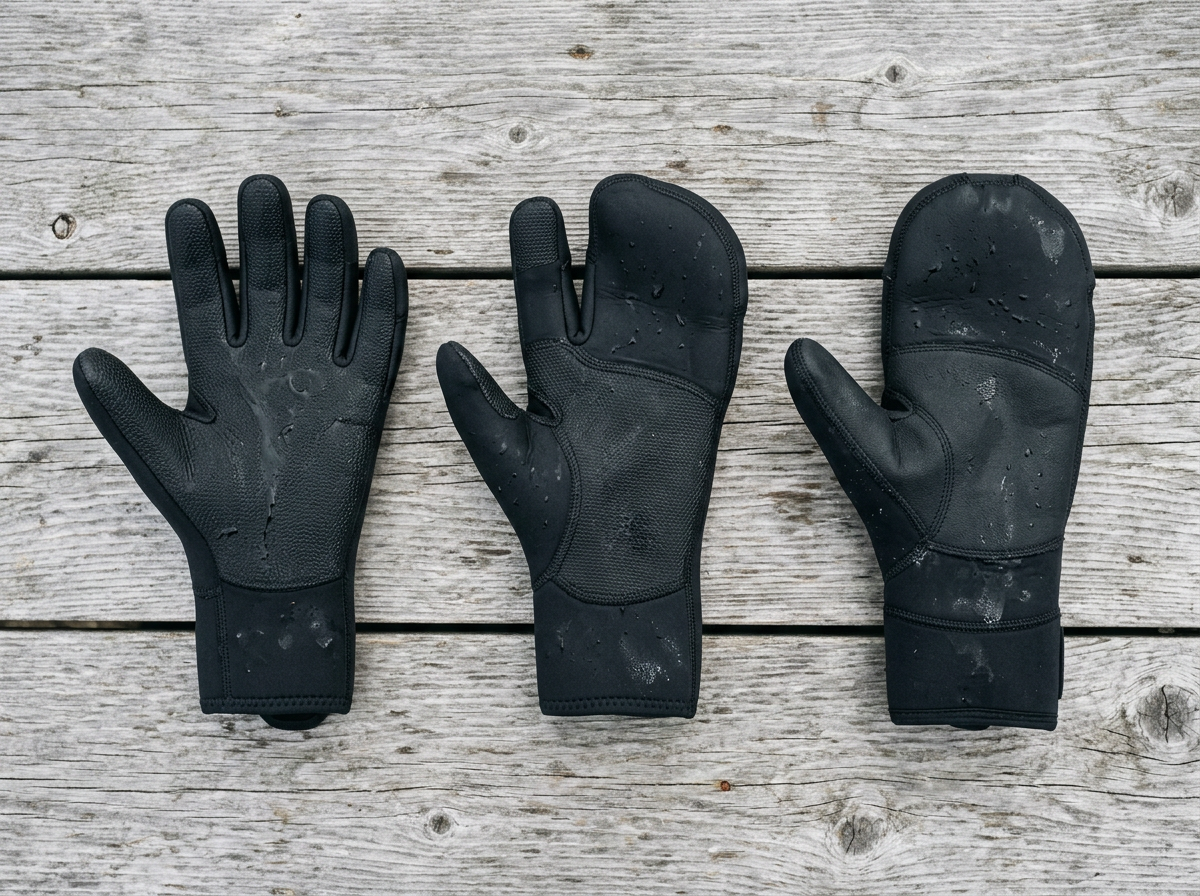
The three styles are a straight warmth against dexterity trade. Cleanline calls the five finger glove the most common cold water choice because each finger stays separate and movement feels natural. It is offered from 1mm all the way to 5mm, which makes it the default for most surfers.
The three finger lobster claw usually puts the thumb and index finger on their own and groups the rest. Rip Curl describes its Flashbomb version as warmer than a five fingered glove and more capable than a mitten, which is the whole argument for the style. Cleanline adds a practical warning: lobster sizing is harder to get right, and fit differs enough between brands that measuring properly matters more here.
Mittens are for the coldest end only. Grouping the fingers keeps far more heat in, and the cost is handling. Popping up, grabbing a rail and sorting a leash all get clumsier. Most 7mm options are mittens for that reason.
Measure your hand before you order
Gloves punish guesswork more than any other neoprene. Cleanline is blunt about it: a glove that is too big flushes and feels like weights on the ends of your arms. Their method is two measurements. Wrap a tape around your palm at the widest point, then measure from your wrist to the tip of your middle finger, and use whichever number is larger.
Match that figure to the chart in the sizing tab, which runs from 2XS at 6 to 6.5 inches through 2XL at 9 to 9.5 inches. Between two sizes, Cleanline says size down, because neoprene stretches with use. Model notes can override that: the O'Neill Psycho Tech 3mm listing calls its own fit snug and suggests sizing up if you dislike a tight glove, adding that the glove moulds to your hand over one to two years.
Cleanline also answers two common questions directly. Gloves are generally unisex and sized to men's hands, with only a small number of women's specific models, and there are no youth specific gloves, though a 2XS fits children down to around five years old.
What separates a cheap glove from an expensive one
Three construction details drive the price. Smooth skin outer panels cut wind and shed water instead of soaking it up, at the cost of durability, since Cleanline notes they tear easily on a fingernail. Seams are either taped with fabric strips or welded with glue or silicon for a water tight seal. Linings add warmth but reduce board feel and dry more slowly than linerless builds.
You can see all three in the current listings. Rip Curl pairs an E6 flash lining with internal seams sealed in silicon and taped externally on the Flashbomb lobster. O'Neill builds the Psycho Tech from TechnoButter 3 with a windproof smooth skin, a Firewall lining and an O'Ring wrist seal. Xcel uses a Celliant Black lining, quick dry fibres and Drylock wrist seals on the Drylock five finger.
Wrist sealing is the detail worth paying for. Every one of those models names its cuff system, because that is where flushing starts.
What surf gloves cost right now
Four verified listings put the working range between roughly $48 and $72. The Rip Curl Flashbomb 5/3 lobster sits lowest at $47.96 against a $59.95 regular price, though the brand's own page showed no stock across sizes. O'Neill's Psycho Tech 3mm five finger is $67.96, and both the Psycho Tech 5mm mitten and the Xcel Drylock 5mm five finger are $71.96, each discounted from $89.95.
That spread is narrow enough that thickness and style should decide the purchase rather than price. It is also early September pricing, when last season's cold water stock is still discounted and the coldest sizes have not sold through yet. Buying gloves alongside surf booties in autumn tends to beat replacing both in January.
Wearing them so they stay dry
Order matters. Cleanline states that gloves belong under the wrist cuff of your wetsuit, so the sleeve overlaps the glove and forms the tightest seal. Pulling the sleeve inside the glove does the opposite and feeds water in on every stroke.
Expect a finite life. Cleanline puts it at around 75 uses before neoprene gloves start deteriorating, and notes that most brands offer a 90 day warranty, shorter than a full suit warranty. Rinsing and drying them the same way you would when washing a wetsuit gets you closer to the top of that range.
Mistakes that cut your winter short
- Buying 5mm for water that rarely leaves the fifties, then never wearing them.
- Ordering by shoe size instinct instead of measuring hand length and palm width.
- Sizing up for comfort and flushing cold water on every duck dive.
- Tucking the wetsuit sleeve inside the glove rather than over it.
- Choosing a mitten when you still need to work a leash and a rail grab.
- Leaving the purchase until midwinter, when useful sizes are gone.
Sources
| Source | What it contributes |
|---|---|
| Cleanline Surf, Surf Wetsuit Glove Guide | Publishes the thickness and temperature bands used below, the five finger, lobster claw and mitten definitions, smooth skin and seam construction notes, the hand measurement method, the size chart, and the answers on warranty and glove lifespan. |
| Xcel Wetsuits, Men's Drylock Texture Skin 5 Finger Glove 5mm | Lists an ideal water temperature of 48F and below, a Celliant Black lining, quick dry fibres, textured wind resistant outer skin, Taitex outer seam, grip palms and Drylock wrist seals. Listed at $71.96 from a $89.95 regular price. |
| Rip Curl, Flashbomb 5/3 3 Finger Gloves | Brand page for the lobster claw model, listing E6 flash lining, non slip palms and seam sealing. Shown as out of stock across sizes at the time of checking. |
| Cleanline Surf, Rip Curl Flashbomb 5/3mm 3 Finger Gloves | Retailer listing at $47.96 from a $59.95 regular price, describing internal seams sealed with silicon and externally taped, and a thickness taper between cuff and hand. |
| Cleanline Surf, O'Neill Psycho Tech 5mm Mitten Gloves | Listed at $71.96 with a TechnoButter 3 exterior, windproof smooth skin, TechnoButter Firewall lining, tacky grip palm and an O'Ring wrist seal. |
| Cleanline Surf, O'Neill Psycho Tech 3mm Gloves | Listed at $67.96 with the same TechnoButter 3 and Firewall construction in a thinner build, plus the retailer's own advice to size up if you dislike a tight glove. |
Video guide
Related reading
FAQ
What thickness surf gloves do I need?
Cleanline Surf publishes bands by water temperature. Gloves of 1mm to 2mm cover roughly 60 to 50F, 3mm covers the high fifties down to 45F, 5mm covers 45 to 35F, and 7mm is reserved for 40 to 30F. Xcel lists its own 5mm Drylock five finger glove as ideal at 48F and below, which sits inside the same range. Air temperature and wind matter too, so a windy offshore morning can justify a glove in water that would otherwise be fine bare handed.
Are five finger gloves, lobster claws or mittens better?
It depends how much you value dexterity against warmth. Cleanline describes the five finger glove as the most common cold water style because each finger moves naturally. The three finger lobster claw splits the thumb and index from the rest, which sits between a glove and a mitten for warmth and control. Mittens keep the fingers together and are far warmer, at the cost of handling your board comfortably.
How do I measure my hand for surf gloves?
Cleanline says most brands ask for two measurements: around the palm at its widest point, and from the wrist to the tip of the middle finger. Take the larger of the two and match it to the brand size chart. Their published chart runs from 2XS at 6 to 6.5 inches through to 2XL at 9 to 9.5 inches of hand length.
Should surf gloves go over or under the wetsuit sleeve?
Under. Cleanline states that gloves should be tucked beneath the wrist cuff of your wetsuit so the suit overlaps the glove and forms the most water tight seal. Reversing that order funnels water straight into the glove every time you paddle.
How long do surf gloves last?
Cleanline puts the working life of neoprene gloves at about 75 uses before they start to deteriorate, and notes that gloves with a few small leaks often stay usable in milder water. The same guide says most wetsuit companies apply a 90 day warranty to gloves, which is shorter than the warranty on a full suit.
Should I size up or down in surf gloves?
Cleanline advises sizing down when you fall between two sizes, since the neoprene stretches with use and a loose glove flushes water. Retailer notes vary by model though: the O'Neill Psycho Tech 3mm listing says the fit is snug and suggests sizing up if you dislike a tight glove, and adds that the glove moulds to your hand over one to two years.
Gloves only work alongside a suit that seals. The wetsuit reviews section ranks current suits using scores collected across retailers and editorial sources, the Xcel Drylock 5/4 hooded review covers the warmest end of that range, and surf accessories collects the smaller gear that keeps a winter session going.