Step Up Surfboard Guide
The wave of the year usually arrives on a day your everyday shortboard cannot handle. You are too far back on the takeoff, the tail keeps skipping on the drop, and the paddle out costs more than the session gives back. A step up fixes that with surprisingly small changes: same model, same width, a little more length and a fraction more thickness. Most surfers get it wrong by buying far too much board, which floats fine and surfs badly. This guide sets out the published dimensional rules from shapers and coaches, the tail and fin choices that come with them, and the step ups Surfex already tracks with their aggregate scores. September is the month the North Pacific starts producing, so it is the right time to order one.

Surfex is an aggregator. Every dimension here comes from a published shaper or coaching guide linked in the sources section, and every board score comes from ratings collected across retailers and editorial outlets.
| Board type | Length vs daily driver | Width | Thickness | What it is for |
|---|---|---|---|---|
| Step up | 1" to 2" longer than your daily driver | Same width | +1/8" to +1/4" | For when all you want is a little more paddle power |
| Semi gun | 3" to 6" longer | Same width | +1/8" to +1/4" | Adds paddle power and draws longer lines |
| Gun | Well beyond a semi gun | Narrower, pulled nose and tail | Foiled for late drops | Big wave territory, outside the scope of a step up |
Step up and semi gun bands published by Stretch Boards.
What a step up actually changes
Stretch Boards gives the tightest definition on record: a step up is your daily driver model, same width, with 1 to 2 inches of extra length and 1/8 to 1/4 inch of added thickness. That is the board you want when all you are really looking for is a little more paddle power. Go 3 to 6 inches longer and you have ordered a semi gun, which is a different board with a different job.
The small numbers matter because the change happens in the water, not on the spec sheet. An extra inch of length and a hair of thickness moves you into the wave earlier and stops the tail chattering on a steep face, without turning your shortboard into something you have to muscle around.
Control, not speed
OMBE makes the point that big waves already contain all the speed you need. A high performance shortboard is built to generate drive in surf that has none. Once the wave supplies the push, the board's job reverses: it has to slow you down, hold a line, and let you engage the rail through a powerful bottom turn.
That is why the common mistake, ordering something much bigger, thicker and wider to feel safe, produces a board that floats well and surfs poorly. OMBE recommends 2 to 6 extra inches and no extra width at all, with a slightly narrower outline being an advantage rather than a risk.
Tail, rocker and rails
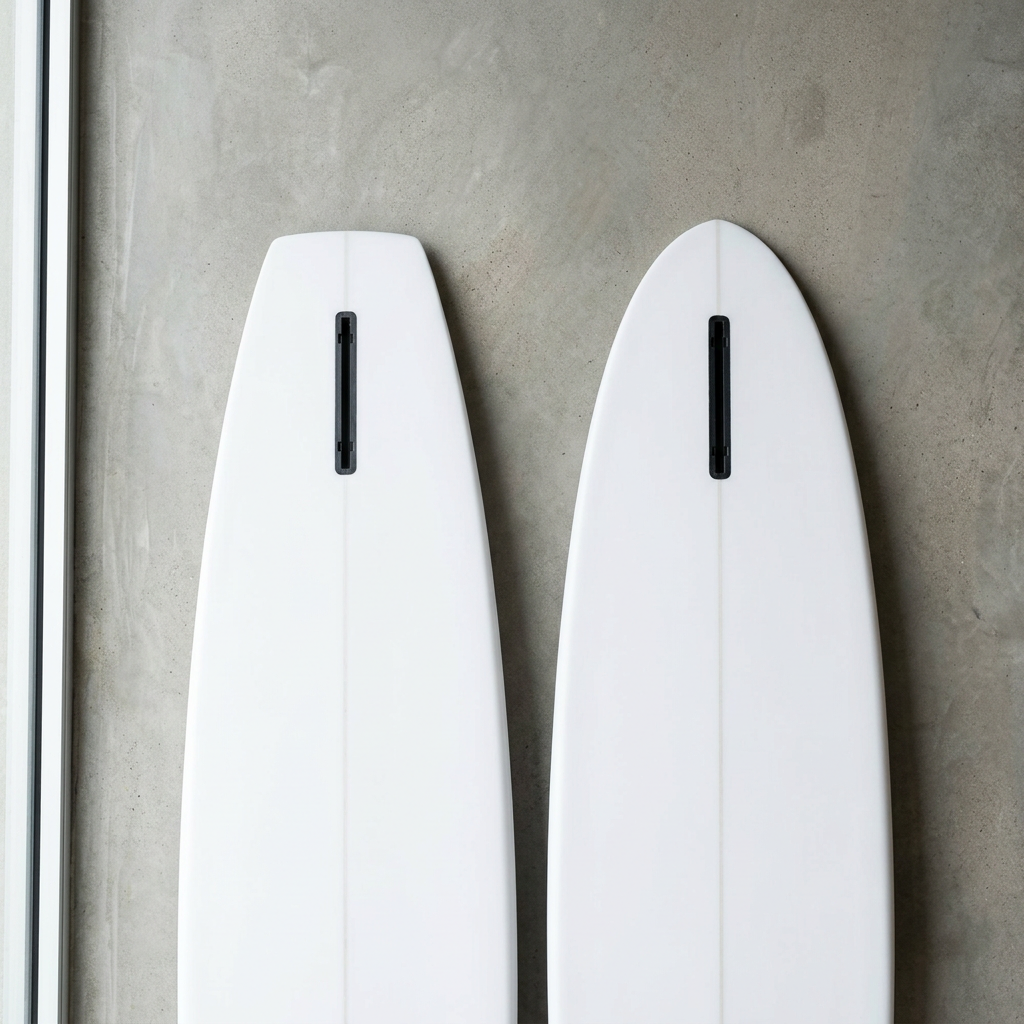
The rounded pin is the default recommendation for a first step up. It digs enough to hold on a steep face while still rolling rail to rail, which a straight pin gives up. Stretch Boards takes a more relaxed view and points out that most riders should carry over whatever tail they already ride, so the step up feels like the same board rather than a stranger.
Rocker goes up, not down. More curve controls speed, lets you stick a late drop and makes re-entry into the face possible. Rails get tapered, and single to double concave through the bottom keeps rail to rail transitions smooth. If any of that vocabulary is new, the surfboard buying guide covers the fundamentals first.
Construction is part of the design
Stretch Boards builds step ups and semi guns in PU or medium to heavy composite lay ups on purpose. The extra mass alters flex response and damps the chatter that travels from the water through the board into your feet at speed. A light small wave build in a step up defeats the point of ordering one.
The same argument runs through the epoxy versus PU comparison, where weight and damping decide the outcome more often than the foam type does.
Match the board to the break
OMBE splits the decision by where you are going. Indonesian reef passes mean long paddles to waves breaking well offshore, so paddle power is the priority. A reef setup like the North Shore rewards maneuverability instead, because the paddle is short and the drop is everything. That distinction changes how much length you should add.
Fin choice follows the same logic. A drive oriented thruster such as the FCS II Accelerator suits most step ups, while a quad set like the Futures Controller Quad adds hold when the face is vertical. The full fins category lists what current templates score.
Which models to look at
The Pyzel Ghost is the model most often named when surfers describe a step up, and Pyzel also runs the Mini Ghost for surfers who want the outline without the full length. Channel Islands covers the travel side with the Happy Traveler, a shape Peter Mel rides in steep, heavy surf in the brand's own footage.
Moment Surf Company's advice for a first order still holds: start with the shaper whose boards you already ride, because the step up is meant to be the same board with more under it.
Mistakes that waste the order
- Adding width along with length, which kills rail engagement in powerful water.
- Ordering 4 or 5 extra inches and ending up with a semi gun you cannot turn.
- Choosing the lightest available construction and getting chatter at speed.
- Flattening the rocker for paddle speed, then eating the late drops.
- Riding it on head high days and deciding the board is slow.
Step ups reviewed on Surfex
Aggregate scores collected from retailer and editorial ratings, shown on a 10 point scale.
| Board | Style | Aggregate score |
|---|---|---|
| Channel Islands CI Pro | Pulled performance shape | 9.4 |
| Pyzel Ghost | Reference step up | 9.2 |
| Channel Islands Happy Traveler | Travel step up | 9.2 |
| Sharp Eye Inferno 72 | Punchy beach break | 9.2 |
| Sharp Eye HT2.5 | Round pin performance | 9.2 |
| Haydenshapes Holy Grail | Round pin all rounder | 9.2 |
| Pyzel Mini Ghost | Shorter Ghost outline | 9.0 |
Fin sets that suit a step up
| Fin set | Type | Aggregate score |
|---|---|---|
| FCS II Mayhem | Upright with rake | 9.6 |
| FCS II Accelerator | Drive and hold | 8.9 |
| Futures Controller Quad | Quad hold in steep faces | 8.8 |
Sources
| Source | What it contributes |
|---|---|
| Stretch Boards — How to size up your next board | Publishes the dimensional rule this guide uses: a step up is your daily driver model at the same width with 1 to 2 inches of extra length and 1/8 to 1/4 inch of added thickness. A semi gun goes 3 to 6 inches longer. |
| OMBE — Guide to the ideal step-up board | Frames the design brief as control rather than speed, argues for 2 to 6 extra inches and no extra width, and names the rounded pin as the safest tail for a first step up. |
| Moment Surf Company — How to buy your first step-up | Shop and team rider advice on ordering a first step up as the North Pacific starts producing autumn swell, and on starting with the shaper you already ride. |
Video guides
Related reading
FAQ
What is a step up surfboard?
It is your everyday shortboard model built slightly bigger so it works when the surf gets past overhead. Stretch Boards defines it as the same model at the same width with 1 to 2 inches of extra length and an added 1/8 to 1/4 inch of thickness, which is enough to restore paddle power without changing how the board surfs.
How much longer should a step up be than my normal board?
Between 1 and 2 inches according to Stretch Boards, or 2 to 6 inches according to OMBE depending on how far you are stepping up. Anything past 3 inches is closer to a semi gun, which paddles harder still but wants longer, drawn out turns.
What size waves is a step up for?
Overhead through double overhead. OMBE puts the design squarely at the double overhead swells you meet on a surf trip, and reserves guns and semi guns for anything bigger. Below head high a step up mostly feels stiff and slow.
Should a step up be wider than my shortboard?
No. Both Stretch Boards and OMBE keep the width the same, and OMBE argues a slightly narrower outline can help. Big waves already supply the speed, so the job of the board is control, and extra width works against engaging the rail.
What tail shape works best on a step up?
A rounded pin is the common recommendation because it holds through a powerful bottom turn while still releasing rail to rail. Stretch Boards notes that many surfers simply carry over the tail they already ride, since a step up should feel like the same board with more under it.
Do I need a different construction for a step up?
Usually a heavier one. Stretch Boards runs step ups in PU or medium to heavy composite builds because the extra mass damps chatter and changes flex response, which is what gives control in fast, powerful water.
Once you have the dimensions settled, the shortboard reviews section ranks current models by scores collected across retailers and editorial sources.