Surfboard Fin Guide
Swapping fins changes a board more than most surfers expect, and it costs a fraction of a new shape. This guide pulls together the fin advice published by shapers, fin retailers and surf-science channels, then points each setup at the sets scored in our fin review index.
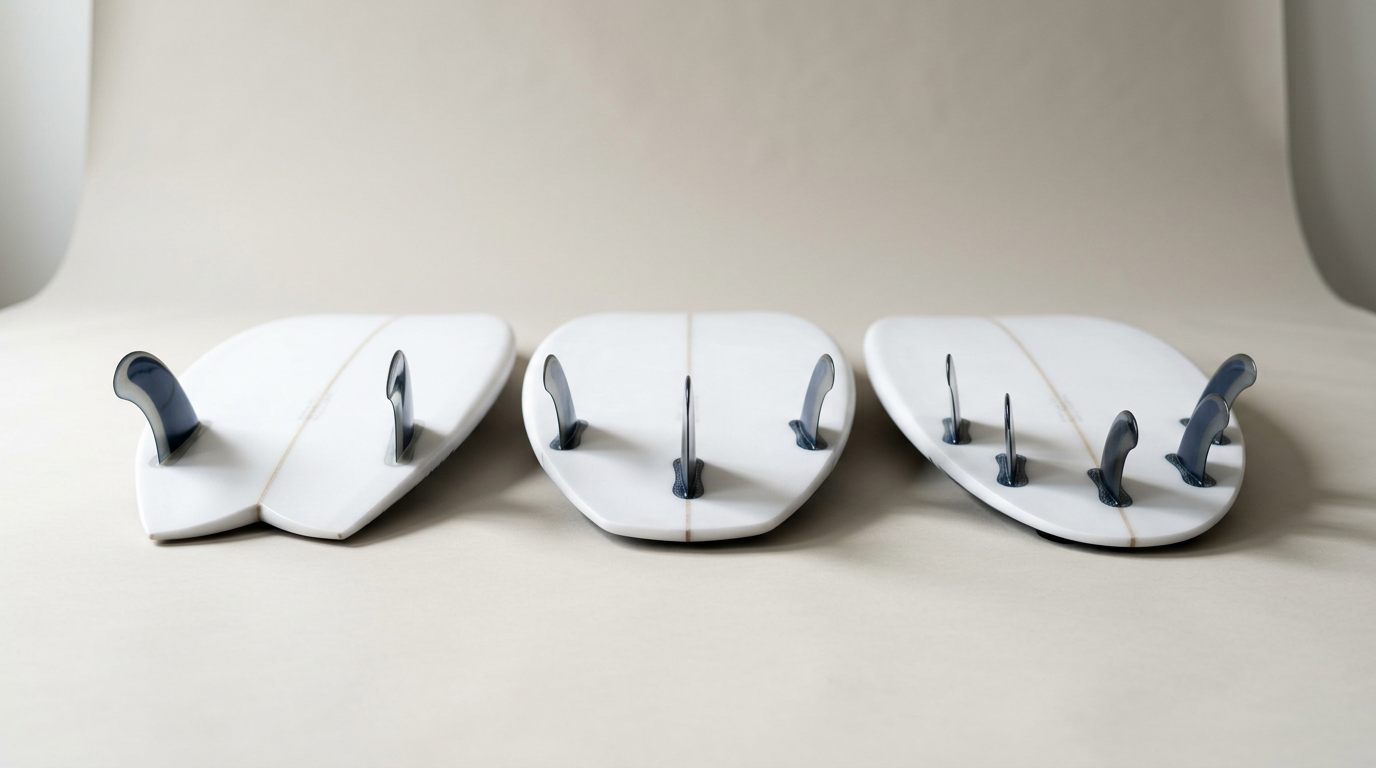
Original Surfex illustration.
Surfex aggregates published fin guides and normalises every score to a /10 scale. We don't accept payment for placement, and every source links to its original page.
Across four independent published guides the advice converges: ride a thruster when you can only own one set, size the fins to your body weight, then move one size up or down for the wave in front of you. Template and flex are the fine-tuning layer, not the starting point.
What fins actually do
A finless board slides sideways. Fins generate lateral lift against the water, which is what lets you set a rail, hold a line across a steep face and convert a turn into forward speed. The first fins arrived in the 1930s and every setup since has traded the same three things against each other: hold, speed and release.
That trade-off explains why two surfers on identical boards can want opposite fins. A heavier surfer in powerful reef surf needs area and stiffness so the tail does not break loose mid-carve. A lighter surfer on a knee-high beach break wants less area so the board still accelerates when the wave offers nothing.
Choosing between thruster, twin and quad
The thruster has held the default position since Simon Anderson's 1980 design because it is the least conditional. The centre fin supplies hold that twins cannot match, and the rail fins turn tighter than a single fin ever will. If you own one board and one set of fins, this is the safe answer.
Twins are the small-wave upgrade most surfers under-use. Removing the centre fin removes drag, so the board planes earlier and feels alive through flat sections. You lose hold when the wave stands up, which is why twin riders usually add two to four inches of length. Our twin fin board reviews cover the shapes built around that feel.
Quads sit between the two and excel at the extremes. In gutless surf they carry twin-like speed; in hollow waves the rear fins lock the tail into the face. Placement matters more than template here. Forward-set rears feel like a fast twin, back-set rears feel like a stiff thruster.
Sizing: weight first, wave second
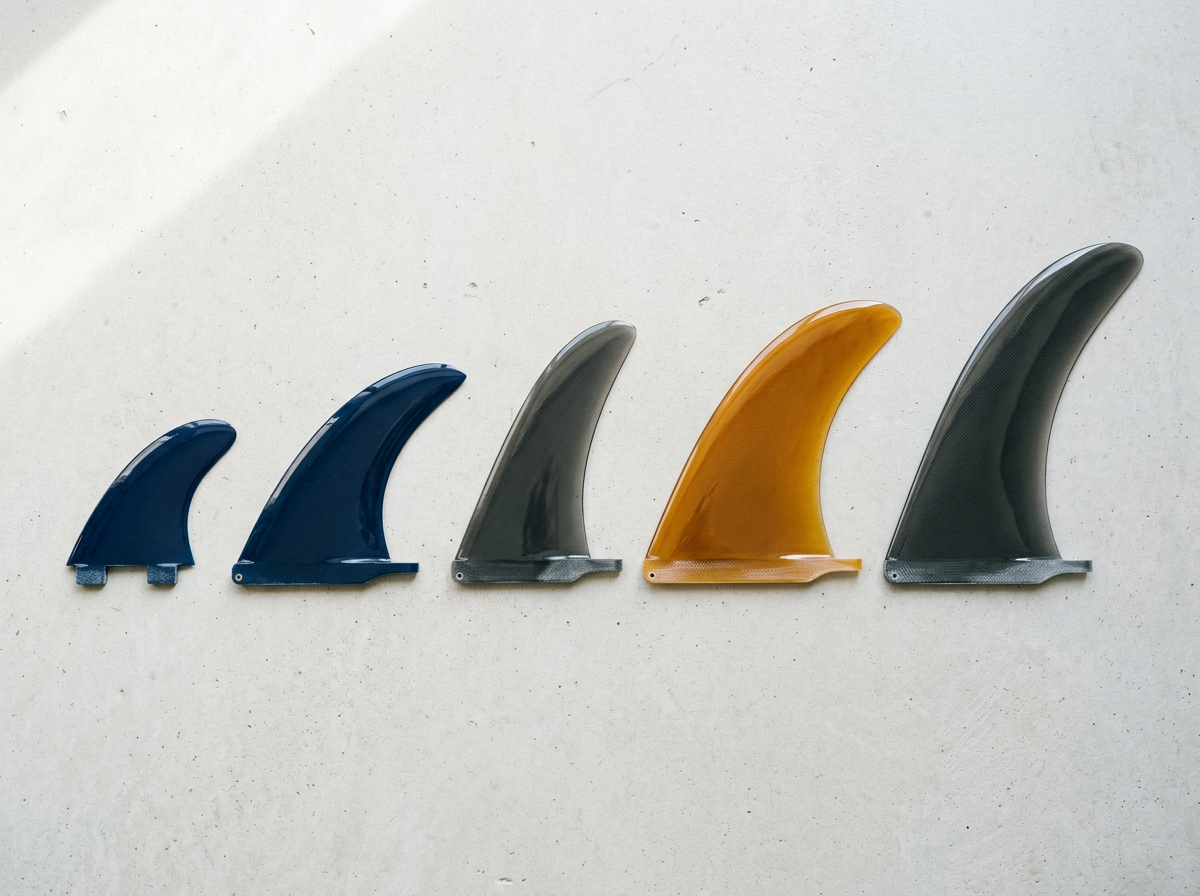
Every published chart starts at rider weight. A 78 kg surfer runs medium; a 90 kg surfer runs large. From that baseline, drop one size for small mushy waves and add one for powerful overhead surf. Twin fins are the exception — because each fin carries more load without a centre fin sharing it, most guides recommend going one size up from your thruster size.
Base length and depth do the work behind those labels. A longer base drives harder through a turn, a shorter base breaks free earlier, and depth controls how much the fin holds when you load it. Most performance thruster fins sit between 4.20 and 4.65 inches of base and 4.50 to 4.80 inches deep.
Box systems: check before you buy
Three formats cover almost every modern board. FCS II plugs take a click-in fin with no screws. Futures uses a single-tab base that slides into a slot and tightens with one grub screw. Longboards and 2+1 mid-lengths use the universal 10-inch centre box. Futures fins do not fit FCS boxes, and older FCS Original bases need an infill adapter to sit properly in FCS II plugs. Look at your tail before ordering, not after. The FCS and Futures brand pages list which templates we have scored in each system.
Rake, foil and flex
Rake is the lean of the tip. Under 25 degrees the fin pivots tightly, which is why noseriding singles are upright. Between 25 and 35 degrees covers the all-round templates. Past 35 degrees the fin draws long, projecting arcs that suit point breaks.
Side fins run a flat inside face and a curved outside face, which generates lift toward the rail. Centre fins are symmetric so they stay neutral. Flex follows material more than shape: fibreglass and carbon-reinforced sets drive hard for heavier surfers, while honeycomb cores forgive imperfect timing and pump speed efficiently in weak surf.
Common mistakes
- Buying a template before checking which box system the board uses.
- Running your thruster size in a twin set, then wondering why the tail slides.
- Mixing brands or sizes across quad fronts and rears.
- Chasing a pro signature template that was designed for waves you never surf.
- Ignoring board volume — fins cannot fix a board that is too small for you. Run our volume calculator first.
Where to start
If your board has FCS II plugs, an all-round set in your weight size covers 90 percent of sessions. The FCS II Carver and FCS II Reactor both sit in that bracket, and the Futures AM2 Techflex is the Futures-box equivalent. Add a keel set such as the FCS II Modern Keel once you start riding twins, and consider a signature template like the FCS II Mason Ho only when you know what feel you are chasing.
What the experts say
| Source | Score | Key takeaway |
|---|---|---|
| Lundquist Surfboards — Fins, A Complete Guide | 9.4 / 10 | "The general rule: bigger surfer or bigger wave = bigger fin. Smaller surfer or smaller wave = smaller fin." |
| Eveley Surf — Choose the Right Surfboard Fin Setup | 9.0 / 10 | "Board shape matters. Waves matter. Skill level matters. But fins are the final control system that determines how your board actually feels under your feet." |
| Eveley Surf — The Complete Guide to Surfboard Fins | 8.8 / 10 | "Every fin choice is a balance between hold, speed, and manoeuvrability." |
| Wikipedia — Surfboard fin | 8.4 / 10 | "Fins can provide lateral lift opposed to the water and stabilize the board's trajectory, allowing the surfer to control direction by varying their side-to-side weight distribution." |
Fin sets worth starting with
Average across the five most-cited sets in this guide: $122 ($105–$170).
| Fin set | Role | From | |
|---|---|---|---|
| FCS II Carver | All-round thruster | $105 | Read review |
| FCS II Reactor | Entry all-rounder | $105 | Read review |
| Futures AM2 Techflex | All-round thruster | $115 | Read review |
| FCS II Modern Keel | Twin keel | $115 | Read review |
| FCS II Mason Ho Signature | One-quiver thruster | $170 | Read review |
Video guides


Related reading
FAQ
What size surfboard fins do I need?
Fin size is set by rider weight first. Under 59 kg (130 lb) runs XS, 59–70 kg runs S, 70–84 kg runs M, 84–95 kg runs L and above 95 kg runs XL. Adjust one size down for small mushy waves and one size up for powerful overhead surf.
Thruster, twin or quad — which fin setup should I ride?
A thruster is the safest single choice because it holds in steep surf and turns tightly. A twin is faster and looser in knee-to-head-high waves but gives up hold. A quad splits the difference: twin-like speed in gutless surf, rear-fin hold in hollow waves.
Are FCS and Futures fins interchangeable?
No. Futures uses a single-tab base that only fits Futures boxes. FCS II fins click into FCS II plugs, and older FCS Original bases need an infill adapter to seat properly in an FCS II box. Check the boxes in your board's tail before buying.
What does fin rake do?
Rake is how far the tip leans back from the base. Under about 25 degrees the fin pivots tightly, which suits pocket turns and noseriding. Between 25 and 35 degrees covers most modern thruster and quad templates. Above 35 degrees the fin draws long carving arcs with more projection.
Do bigger fins make you slower?
More fin area adds hold and drive but also drag, so a large set feels stiff in weak surf. Smaller fins release earlier and generate speed through pumping, at the cost of hold when the wave stands up. Match area to the wave, not just your weight.
How much should a set of surfboard fins cost?
Across the five sets most often recommended in this guide, prices run from $105 to $170, averaging $122. Honeycomb and performance-core sets sit near the bottom of that band, signature and carbon templates near the top.
Aggregated from 4 independent editorial sources and 4 video guides. Average set price $122.