How to Choose a Surfboard
The wrong board costs you waves before you have paddled a stroke, and almost everyone gets it wrong the same way. Rusty Preisendorfer, who has shaped for four decades, puts it plainly on Shaper Made: most surfers are riding boards too small, chosen for how they look under an arm rather than how they feel underfoot. The fix is not a brand or a model. It is a number, worked out from your weight, your fitness and how often you actually get wet, then applied to the board family that suits your local waves. This guide walks through the volume maths the major shapers publish, the shape decisions that matter once the litres are settled, and the sizing ranges for each level so you can walk into a shop knowing what you are asking for.
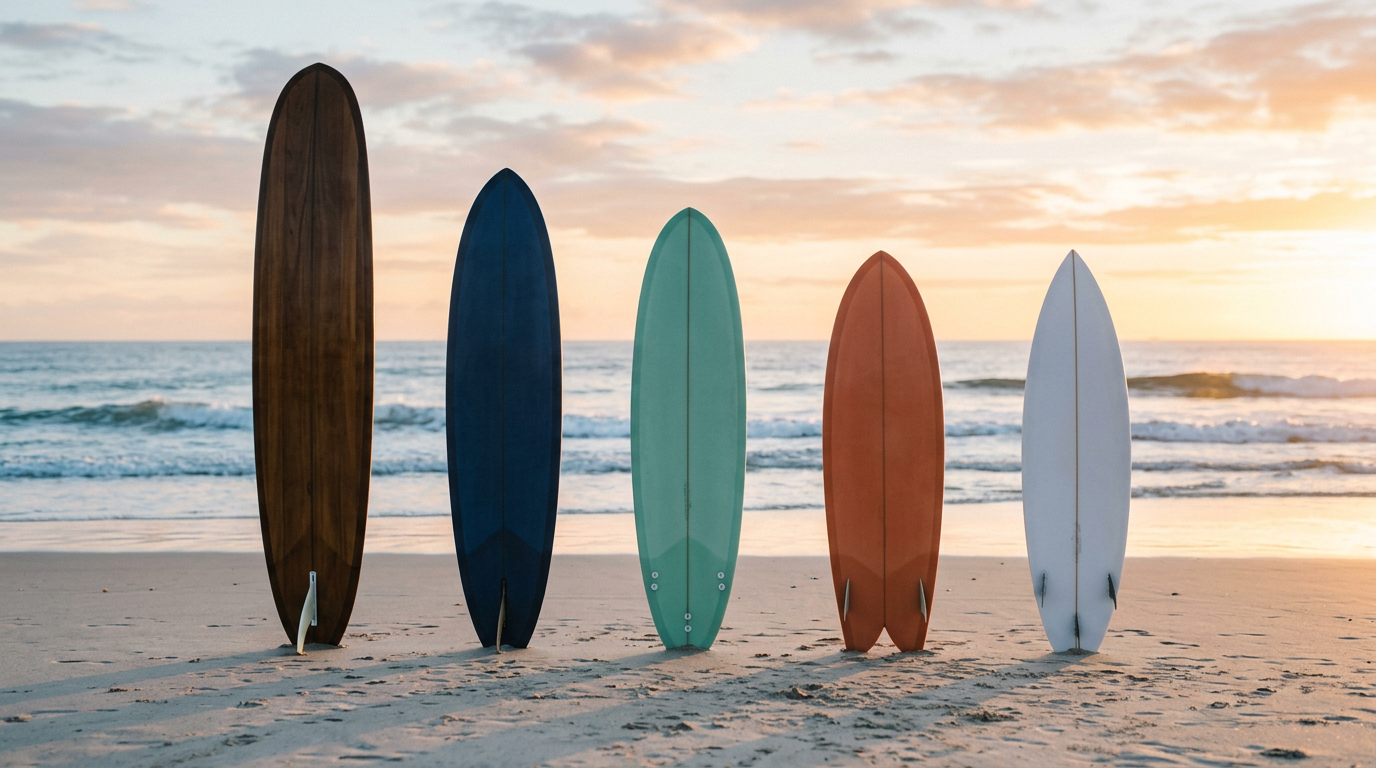
Original Surfex illustration.
Surfex aggregates published shaper and manufacturer guidance, and normalises every score to a /10 scale. Every source links to its original page.
Settle the litres first. The model name only matters once the float is right for your weight.
Surfing twice a month and surfing four times a week put you in different litre brackets entirely.
Where the volume sits changes paddling more than the total number ever does.
Start with litres, not feet and inches
Length is the number surfers quote and volume is the number that decides whether you catch waves. A 6'0 can be 24 litres or 34 litres depending on how wide and thick it is, and those two boards belong to different surfers.
...Lost publishes the ratio most shapers work from. Advanced, extremely fit surfers sit between 0.34 and 0.36 litres per kilo of body weight. Average to above average skill with typical fitness sits between 0.36 and 0.38. Run the maths before you look at a single board: an 82kg surfer of average fitness is looking for roughly 30 to 31 litres, not the 27 litres their favourite pro rides.
Fitness is the input everyone skips
Preisendorfer is direct about it. If you only get in the water once or twice a month and you go off an average size chart, you are doing yourself a disservice. Paddle fitness fades faster than technique, and a board sized for the surfer you were two summers ago will feel like it is sinking.
JS Industries folds height, weight, age, fitness and the waves you regularly surf into its recommendation for the same reason. Two 75kg surfers can need four litres of difference between them, and the one who surfs twice a week is not the one who needs the extra.
Pick the family, then the dimensions
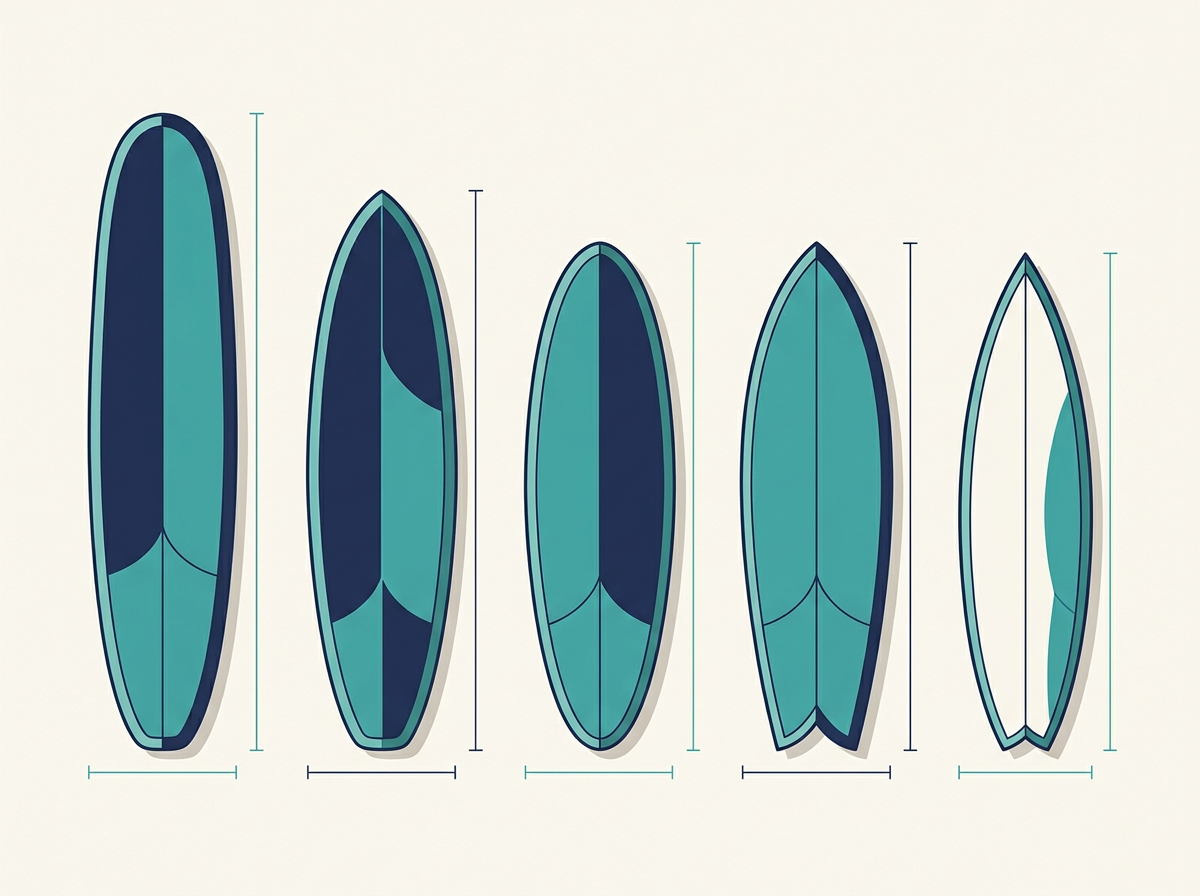
NSP structures its guide the right way round: choose shortboard, fish, midlength or longboard first, then apply your ability and weight inside that family. Volume behaves differently in each. Thirty litres spread across a wide twin fin paddles into a two foot wave that the same thirty litres in a narrow shortboard will miss completely.
Base the choice on the waves you get most often, not the ones you get twice a year. If your home break is waist high three weekends out of four, a small wave board is your everyday board and the step-up is the specialist.
Width, thickness and rocker
Once litres are set, the distribution decides how the board behaves. Width through the chest and a flat entry rocker mean early paddle speed and easy take-offs. A narrower nose with more lift lets you go late and vertical but demands a stronger paddle.
Thickness matters at the rail rather than the stringer. A board that carries its foam out to the rails floats better at rest but is slower to roll rail to rail, which is why beginners are told to look for boxy rails and intermediates start asking for a tucked-under edge.
Step down slowly
The single most useful rule in Preisendorfer's piece is a limit rather than a target: when you go shorter or smaller, keep the increments to six inches or less. He describes customers who have mastered an eight foot soft-top wanting to jump onto a 6'2, and the answer is no.
A staged path works better. Eight foot foamie to a 7'2 funboard, then a 6'8 midlength or hybrid, then a 6'4 with a shortboard outline. Each step keeps your wave count high enough that your surfing keeps improving, which is the only thing that earns you the next drop in size. Our beginner surfboard guide covers the first two rungs in detail.
Construction changes the feel more than the label
PU blanks with polyester resin are the traditional build. They flex, they damp chop, and most surfers describe them as sitting into the water. EPS foam with epoxy resin is lighter and more buoyant at the same volume, more resistant to dings, and livelier in weak waves.
Neither is better in the abstract. Windy, punchy beach break rewards PU. Small, soft summer surf and long travel days reward epoxy, and a board bag matters more in that second case, which is what our travel bag guide exists for.
The details that get forgotten at the counter
- Check the fin system. FCS II and Futures boxes do not share fins, and a good set is expensive.
- Ask whether the quoted volume is the shaper's figure or an estimate from a dealer listing.
- Budget for a leash and traction pad in the same purchase rather than a month later.
- Read the tail shape. Squash for all round, swallow for drive in weak waves, round for smoother arcs.
- If you are between two sizes and unsure, take the bigger one. You can surf a board that is slightly too big.
What to do before you buy
Work out your litre range this week, then borrow or demo something inside it before spending. One session tells you more than an afternoon of forum reading. If the wave count jumps, you have your number, and every future board can be chosen against it. If it does not, add two litres and try again. Browse surfboard reviews by category to see which models sit in your range, and check the fin guide before you commit to a system you will be buying into for years.
What the sources say
| Source | Score | Key takeaway |
|---|---|---|
| Shaper Made — Rusty Preisendorfer | 9.5 / 10 | "Most surfers are riding boards too small. I used to say, volume is your friend. What I really mean is length, volume, width are your friends." |
| JS Industries — Volume calculator | 9.0 / 10 | "Every other major variable, from height/weight, age and fitness to the waves you surf regularly have been taken into account to get you closer to your ideal surfboard." |
| ...Lost Surfboards — Volume calculator | 8.8 / 10 | "Advanced, extremely fit, high performance surfers range from .34gf to .36gf. Typical fitness with average to above average skills range from .36gf to .38gf." |
| NSP Surfboards — Volume and model guide | 8.6 / 10 | "Find the right surfboard volume based on your skill level, board type, height, and weight. Choose from Shortboard, Fish, Midlength, or Longboard, then select your ability." |
The eight steps in full
- 1Be honest about how often you surf
Rusty Preisendorfer's point is that surf fitness, not ambition, sets your size. Surfing once or twice a month and buying off an average size chart puts you on a board you cannot paddle. Once or twice a week is the threshold where a smaller, tighter outline starts to make sense.
- 2Work out a volume range from your weight
...Lost publishes the ratio most shapers work from: multiply your body weight in kilograms by roughly 0.34 to 0.36 if you are fit and advanced, and 0.36 to 0.38 if your fitness and skill are average or better. An 80kg surfer lands somewhere between 27 and 30 litres on a shortboard.
- 3Add litres for the things that slow you down
Age, a long gap since your last session, a thick winter wetsuit, and weak or gutless waves all push the number up. JS builds these into its calculator rather than treating them as excuses. Take the top of your range instead of the bottom whenever two of them apply.
- 4Pick the board type before the dimensions
NSP splits the decision into shortboard, fish, midlength and longboard first, then applies the volume figure inside that family. A 32 litre shortboard and a 32 litre fish paddle and surf nothing alike, so choose the category that matches your waves.
- 5Use width and thickness, not just length
Volume is distributed, not just totalled. Extra width through the middle and a flatter entry rocker lift wave count more than an extra half inch of length. A wide, low-rocker outline catches more, a narrow one turns tighter.
- 6Step down in small increments
Preisendorfer's rule is to keep changes to six inches or less when going shorter. Jumping straight from an eight foot soft-top to a 6'2 shortboard removes every bit of paddle power you rely on, and the wave count collapses.
- 7Match construction to your waves and budget
PU with polyester resin flexes and damps chop, which suits punchy beach breaks. EPS with epoxy is lighter and floatier for the same litres, which helps in weak waves and makes the board more resistant to dings.
- 8Check the fin system before you pay
FCS II and Futures boxes are not interchangeable, and your existing fins only move to a new board if the boxes match. Decide which system you are staying with, because a set of quality fins costs a meaningful fraction of the board.
Video guides


Related reading
FAQ
What size surfboard should I get for my weight?
Start from the ratio ...Lost publishes: body weight in kilograms multiplied by 0.34 to 0.36 for fit advanced surfers, and 0.36 to 0.38 for average fitness and skill. An 80kg surfer of average fitness lands near 29 to 30 litres on a shortboard. Beginners and midlength riders need far more, often 0.55 to 1.0 times body weight in litres.
How much volume do I need in a surfboard?
Volume in litres is set by weight, ability, fitness, age and the waves you surf. JS and NSP both build their calculators from those inputs rather than height alone. Take the higher end of your range if you surf less than once a week, wear a thick wetsuit, or ride mostly weak waves.
Is it better to have a longer or shorter surfboard?
Longer paddles faster and catches more waves, shorter turns tighter and fits steeper faces. Rusty Preisendorfer says most surfers ride boards that are too small, and recommends dropping no more than six inches at a time when you do step down.
Should I buy an epoxy or PU surfboard?
PU with polyester resin flexes more and settles better in choppy, punchy waves. EPS with epoxy is lighter and floatier for the same litres, so it suits weak summer surf, travel and anyone who wants a more ding-resistant board.
What surfboard should an intermediate surfer ride?
A hybrid or fuller shortboard around your height plus two to six inches, at roughly 0.4 to 0.45 times your body weight in kilograms as litres. Keep the outline wide through the chest and the entry rocker low so the board still catches average waves.
How do I know if my surfboard is too small?
The signs are a low wave count, late take-offs, and arms that give out before the session does. If you are missing waves other surfers on similar boards are making, add litres before you change anything else about your equipment.
Aggregated from 4 published shaper and manufacturer sources and 5 video guides.