Surf Etiquette: The Rules of the Lineup
Almost every argument in the water traces back to one question that nobody asked in time: whose wave was that? Surfing has no referee, so the lineup runs on a small set of rules that experienced surfers apply without discussing them. BBC Wales reduces the whole code to a single non-negotiable item, the drop-in rule, and everything else follows from it. Get priority right and a crowded peak becomes workable. Get it wrong and you collect a fin cut, a snapped board, or a reputation you cannot paddle away from. This guide sets out the nine rules that published surf bodies, councils and lifesaving organisations agree on, explains how priority is decided in the five situations you will actually face, and covers the parts beginners get wrong most often.

Original Surfex illustration.
Surfex aggregates published surf-body, council and lifesaving guidance, and normalises every score to a /10 scale. Every source links to its original page.
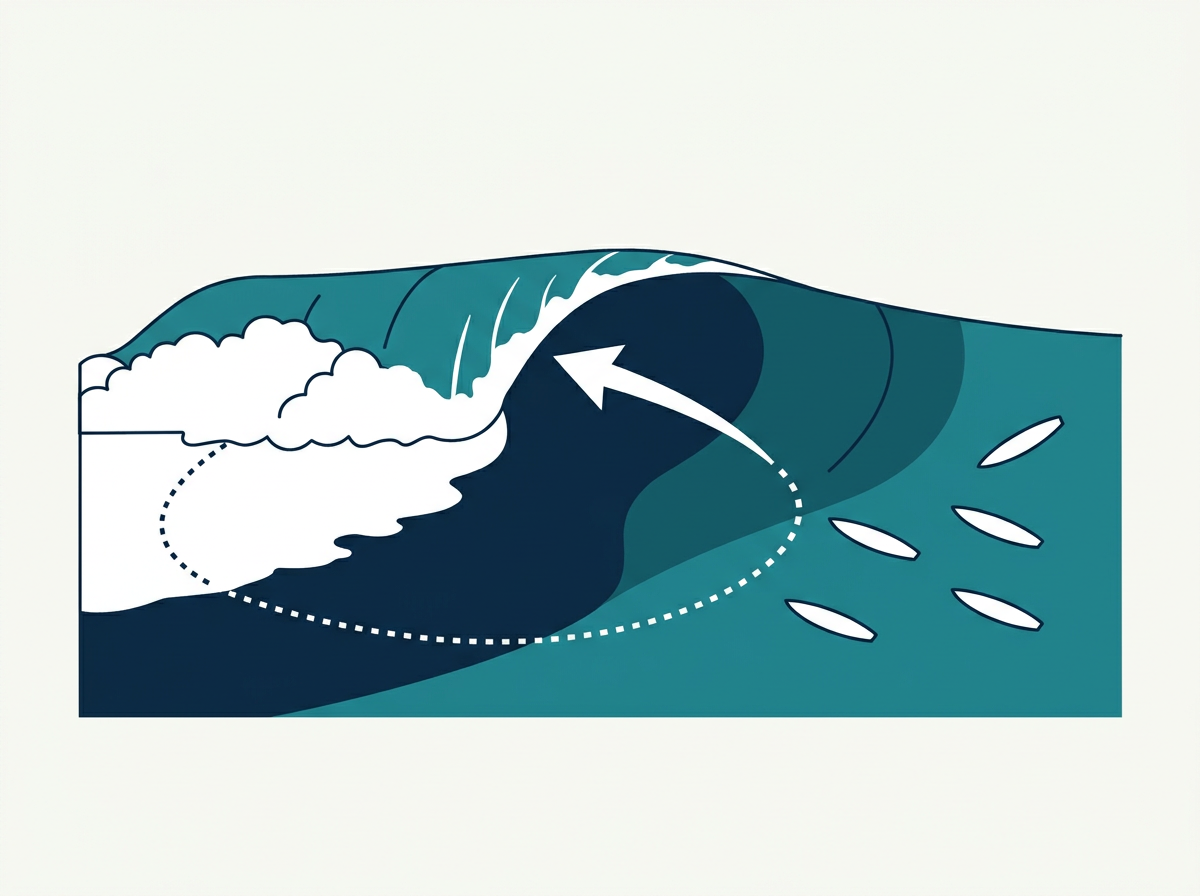
Priority sits with whoever is nearest the breaking peak, and everyone else pulls back.
A shoulder check toward the peak turns most drop-ins into a wave you happily let go.
A loose board is the most common injury source in a crowded lineup, per lifesaving guidance.
Priority is a position, not a personality
The rule every published source states the same way: the surfer closest to the breaking peak owns the wave. It has nothing to do with skill, board or how long you have surfed the break. It is geometry, decided fresh on every wave.
That is why the rule is workable. You can read a position from twenty metres away in a second and a half, which is roughly the time you have to decide whether to paddle.
The shoulder check does most of the work
Surfing England pairs priority with an instruction: always check over your shoulder toward the peak before you commit. Nearly every accidental drop-in comes from skipping that half second.
Make it automatic and something useful happens. You start seeing the lineup as a sequence rather than a scramble, and you catch more waves because you stop wasting energy on ones that were never yours.
Dropping in versus snaking
They get lumped together and should not be. A drop-in is usually a misread: you paddled, someone deeper was already riding, and the fix is to kick out and apologise. Snaking is intent. You saw the set, you paddled around a surfer who was waiting, and you took the inside on purpose.
The City of Del Mar and Billabong both rank snaking as the more serious offence, and the reason is social rather than physical. A lineup tolerates mistakes. It does not tolerate someone quietly rewriting the queue.
Paddle out through the channel
Watch the water for a few minutes before you go, find where the waves are not breaking, and time your run between sets. Surfing England adds the rule that saves collisions: if a surfer is riding at you, turn toward the whitewater behind them, never toward the open shoulder they are aiming for.
Being caught inside is part of surfing, and getting back out cleanly is a skill in itself. Our duck dive guide covers the timing, and the surf report guide helps you pick a session where the set intervals give you a gap in the first place.
Board control is a safety rule, not a style rule
Surf Life Saving New Zealand puts a loose board alongside drop-ins as a leading cause of injury, and its advice is short: keep yours close and always wear a leg rope. A ditched board travels the full length of its leash and then some, straight at whoever is paddling behind you.
Leash choice matters here more than people assume. A cord that is too light for the conditions snaps at the exact moment the board is most dangerous, which is why the leash guide starts with wave size rather than price.
Wave hogging and the longboard problem
Surfing England and Del Mar both single out longboards and SUPs, not out of prejudice but because a high-volume board catches waves earlier and further out than a shortboard can. Ride one and you can pick off every set wave before the rest of the lineup gets a look.
The fix is simply awareness. Let a few through, and call someone into one. It costs you a wave and buys you an afternoon of goodwill.
Pick a break you can actually surf
Del Mar frames this as an etiquette rule rather than a safety one, and both are true. A surfer out of their depth drifts into the impact zone, loses their board and gets in the way, all without intending anything. If you are unsure about a spot, ask a lifeguard before you paddle out.
Board choice is half the answer. Something with enough float for the conditions keeps you out of the way and in the right position, which our beginner surfboard guide and volume calculator both work through.
Respecting locals is mostly just patience
Del Mar's advice is practical rather than deferential: do not arrive in a large group, do not paddle straight to the peak, take your time. Locals surf the spot daily and read it better than you will on day one, so sitting slightly wider for the first session costs almost nothing.
- Watch from the beach for five minutes and find the channel before you get wet.
- Take a wide position on your first few waves rather than the deepest spot.
- Say hello. A single friendly exchange changes how the next hour goes.
- Split up if you arrive with a group, rather than filling the peak at once.
- Take your rubbish home, which Surfing England lists as part of the same code.
What to change on your next session
Work on one thing: the shoulder check. Do it before every wave for a full session, even the ones where you are obviously alone. Once it is a reflex, priority stops being a rule you remember and becomes something you see. Everything else on this list, from paddling wide to holding your board, follows from noticing where other people are before you commit. If you are heading somewhere new, read up on the break first through our surf trip guides.
What the sources say
| Source | Score | Key takeaway |
|---|---|---|
| Surfing England — Surf etiquette | 9.4 / 10 | "The surfer who is nearest to the peak of the wave has priority, or right of way. If you are paddling for a wave always check over your shoulder, looking toward the peak." |
| BBC Wales — Surfing etiquette | 9.1 / 10 | "There are very few rules in surfing which you must abide by, but the 'drop in rule' is one of them. This is the single most important rule to learn and adhere to while out surfing." |
| City of Del Mar — Surfing etiquette | 8.9 / 10 | "Learn who has the right of way on the wave: furthest out, furthest inside, first to feet, and the call of 'Left!' or 'Right!' if the wave is dual-peaking." |
| The Surfing Handbook — 10 surf rules to learn | 8.8 / 10 | "The surfer closest to the peak of the wave is the surfer with priority and has the right of way. If you're paddling for a right, and a surfer on your left is also paddling for it, you must yield." |
| Surf Life Saving New Zealand — Surfing safety | 8.6 / 10 | "A runaway board can damage other boards, or worse, injure other surfers. Keep yours close, and always wear a leg rope." |
| Billabong — Surfing etiquette guide | 8.4 / 10 | "What's worse than dropping in? Snaking, which is paddling around another surfer to steal the right of way and take off on a wave." |
The nine rules in full
- 1Work out who has priority before you paddle
The surfer closest to the breaking peak owns the wave. Surfing England, The Surfing Handbook and Billabong all state the same rule in the same words, which makes it the closest thing surfing has to a written law. On a dual-peaking wave the two surfers split it and call their direction.
- 2Look over your shoulder every single time
Before you commit, turn and check toward the peak. Surfing England makes this the practical half of the priority rule, because priority you did not look for is priority you will take by accident.
- 3Never drop in
Paddling into a wave someone is already riding puts a fin and a hard rail on a collision path. BBC Wales calls it the single most important rule in surfing. If the peak side is occupied, pull back.
- 4Do not snake
Repeatedly paddling around someone to claim the inside position is queue-jumping with extra steps. Del Mar and Billabong both list it as worse than an accidental drop-in because it is deliberate.
- 5Paddle out wide of the break
Time your paddle out between sets and stay in the channel. If a surfer is riding toward you, change direction and head for the whitewater behind them rather than the open shoulder they are aiming at.
- 6Hold on to your board
Surf Life Saving New Zealand is blunt about this: a runaway board damages other boards and injures other surfers. Wear a leash that suits your board and duck dive or turtle roll instead of ditching.
- 7Share the waves
Del Mar and Surfing England both flag wave hogging, and both single out longboards and SUPs because they catch waves earlier than everyone else. Let sets through, and call someone else into one.
- 8Pick a spot inside your ability
Surfing a break beyond your level turns you into a hazard rather than a participant. Del Mar recommends checking with a lifeguard when you are unsure about a spot you have not surfed before.
- 9Apologise when you get it wrong
Everybody breaches etiquette eventually. Del Mar and Billabong give the same advice: say sorry, get out of the way, and the moment passes. Silence is what turns a mistake into a confrontation.
Video guides




Related reading
FAQ
What are the basic rules of surf etiquette?
The surfer closest to the peak has priority, never drop in on a wave someone is already riding, never snake around another surfer for the inside, paddle out wide of the break, hold on to your board, share waves rather than hogging them, surf a spot within your ability, and apologise when you get something wrong.
Who has right of way on a wave?
The surfer nearest the breaking peak. Surfing England, The Surfing Handbook and Billabong all define priority this way. On a wave peaking both directions the two surfers split it and call left or right. On a long point, the surfer furthest out or waiting longest has the claim.
What does dropping in mean in surfing?
Catching a wave that another surfer is already up and riding, so you end up in front of them on the same face. BBC Wales calls it the single rule you must abide by. It is dangerous because the surfer behind has no exit and your fins are in their path.
What is snaking in surfing?
Paddling around another surfer to take the inside position and claim priority on a wave they were waiting for. Unlike an accidental drop-in it is deliberate, which is why Del Mar and Billabong both treat it as the more serious breach.
Where should you paddle out?
Through the channel, wide of where waves are breaking, timed between sets. If a surfer is riding toward you, turn and paddle behind them into the whitewater rather than out toward the shoulder they are heading for.
Should you ever throw your board away?
Only as a genuine last resort. Surf Life Saving New Zealand notes a loose board damages other boards and injures other surfers, so wear a leash and duck dive or turtle roll instead of letting go.
Aggregated from 6 independent published sources and 5 video guides.