Surfboard Leash Guide
A leash is the cheapest part of your setup and the only one that decides whether a wipeout costs you ten seconds or a two hundred metre swim. Two numbers do almost all the work: how long the cord is and how thick it is. Everything else on the packaging, from cuff padding to swivel counts, changes comfort rather than whether the thing holds. The published rules are consistent across retailers and brands, which makes this one of the easier gear decisions to get right, and prices sit between $36 and $95 depending on whether you are surfing waist high beach break or something with real consequence. Fit it wrong and even a good cord will chew through your rail, so the attachment method matters as much as the model on the label.
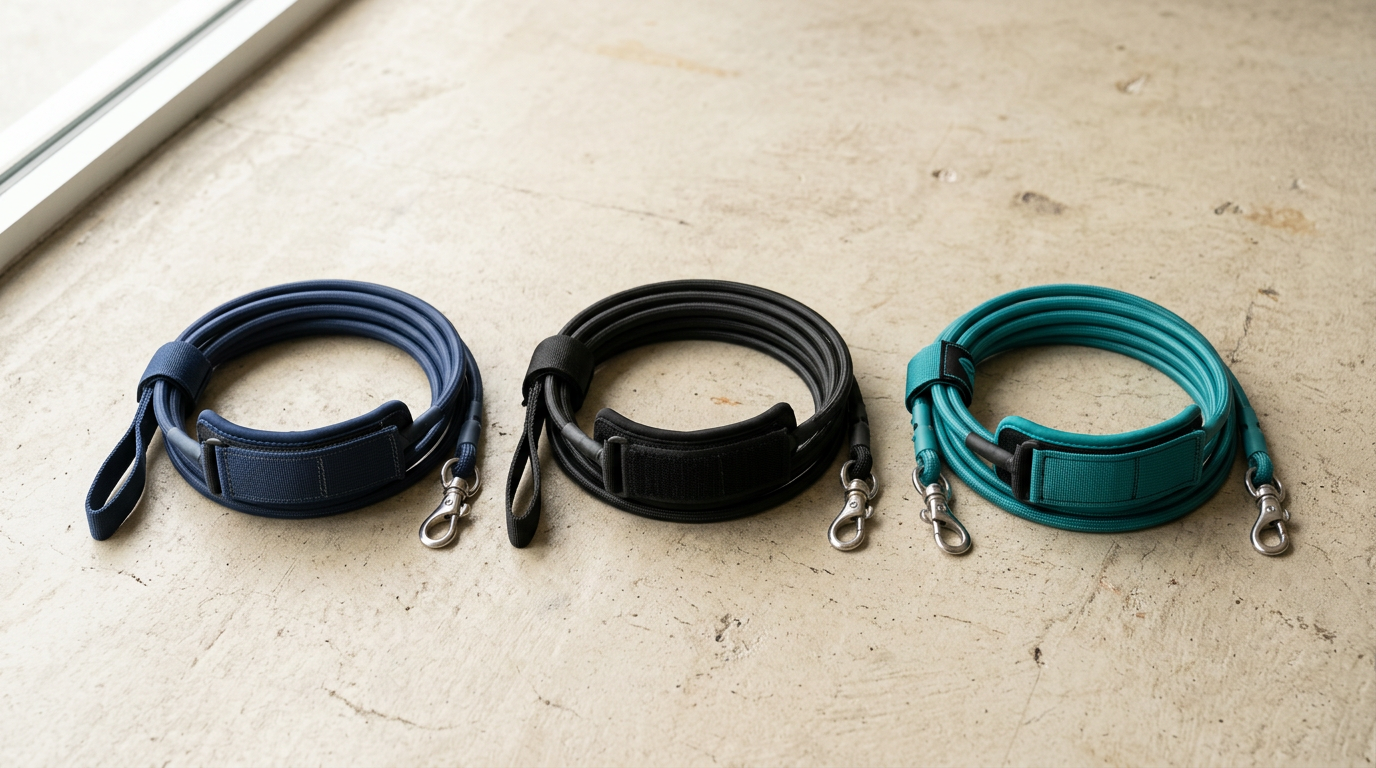
Original Surfex illustration.
Surfex aggregates published retailer specs and editorial guidance, and normalises every score to a /10 scale. Every source links to its original page.
The short version from five sources: buy a leash the same length as your board, take a 5mm to 6mm comp cord for small waves on a shortboard, take a 7mm to 8mm regular cord if you are learning or the surf has size, and expect to pay between $36.00 and $94.95. Attachment method matters as much as the model.
Length: match the board, then round up
Every source says the same thing. Your leash should be at least as long as your board, and when the board sits between sizes you go up rather than down. Creatures stocks 5ft to 12ft and states the rule directly, and Foam Magazine reduces it to a single line: never shorter than the board.
Too short and the cord loads up before you have cleared the board, which is how a rebounding nose finds your ribs. Too long and you are dragging extra urethane through every turn and giving your board a wider arc to swing into other surfers. On a 5'10 groveller from our shortboard reviews a 6ft cord is right. On a 9'2 log from the longboard section you want 9ft or 10ft, worn on the calf.
Thickness is the decision that actually costs you
evo puts competition cords near 4.7mm and regular cords near 8mm. Creatures splits the same range into duty ratings: lite and medium duty at 5mm to 6mm, standard through extra heavy duty at 7mm to 9mm. Thin cord tangles less and drags less, which is why comp models exist at all. Thick cord survives repeated bails and heavy water.
The failure mode is predictable. Creatures is blunt about riding a comp cord in large surf: expect to be treading water out the back while your board sits on the sand. If your session mix is mostly chest high beach break, a comp leash is fine. If a reef pass trip like the Mentawais is on the calendar, pack a regular cord as well.
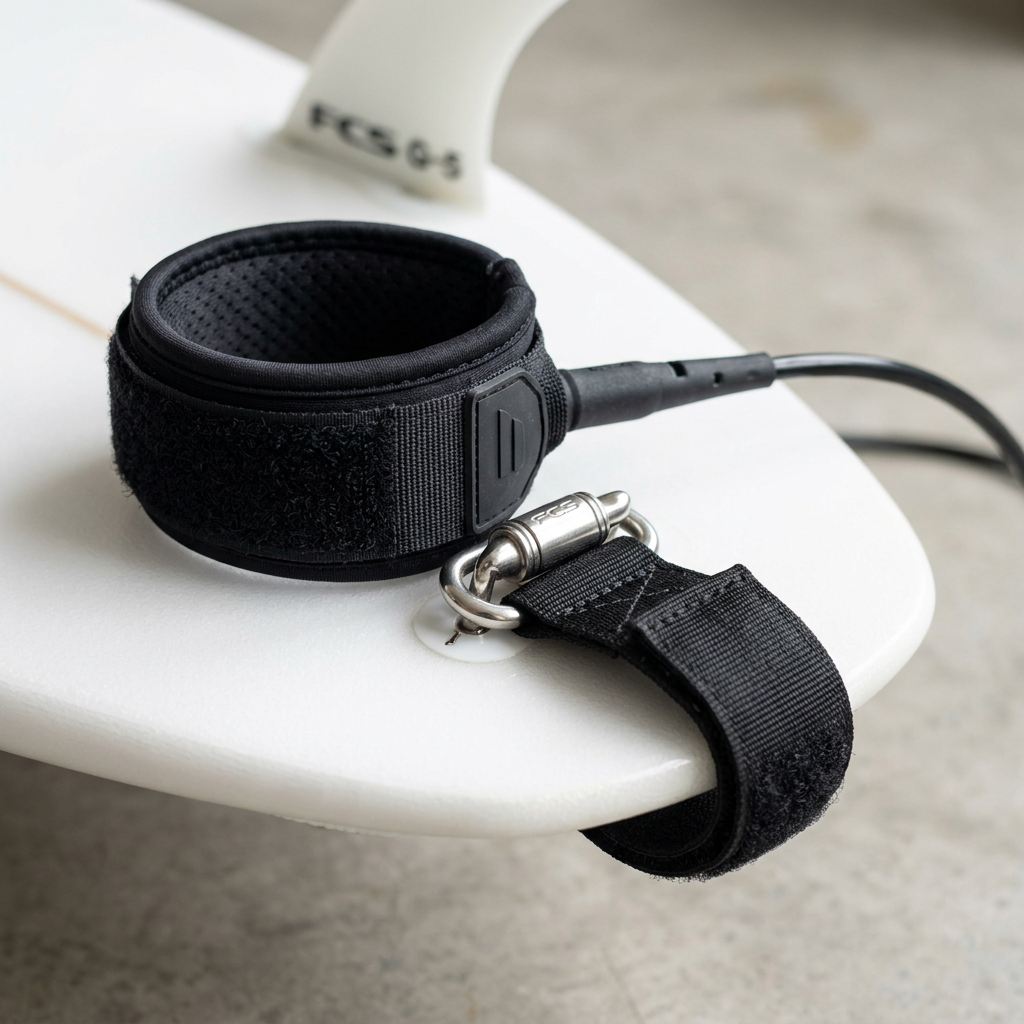
Cuff, swivels and rail saver
Beyond the cord, three parts separate a cheap leash from an expensive one. The cuff decides comfort over a two hour session, and slimmer ankle fits exist for surfers who find standard cuffs loose. Swivels at both the cuff and the rail saver stop the cord from coiling into a spring, and a seized swivel is the most common reason a leash starts wrapping your legs.
The rail saver is the flat webbing that sits across the tail. Without it, a loaded cord pulls straight against the rail and cuts into the lamination, which turns a cheap part into an expensive repair from our ding repair guide.
Ankle, calf or knee
Ankle cuffs are the default and the easiest to reach when you want to pull your board back. Longboarders use calf cuffs so the cord stays clear while they step forward, and Cleanline stocks calf models as a separate category alongside a small number of knee and bicep options. Knee cuffs tangle less on a longboard but are harder to grab mid-wipeout.
Brand-specific fits matter here too. FCS runs its Essential cuffs across ankle and calf versions of the same cord, while Channel Islands splits its range into comp and everyday models at $38 and $40 respectively.
What a leash costs in 2026
The everyday band is tight. Dakine's Kainui Team starts at $36.00, Channel Islands comp cords are $38.00, VEIA's Explorer Standard is $39.95, and the FCS All-Round Essential is $48.00. Above that you are buying either a specialist build or a signature model: the FCS Freedom Helix is $70.00 and the VEIA John John Florence big wave cord is $94.95.
Against the cost of a new board, replacing a tired leash every season is trivial insurance. Budget for it the same way you budget for a fresh traction pad or a new set of fins.
Mistakes that end sessions early
- Tying the cord straight to the plug with no rail saver, so the webbing saws into the tail.
- Running a comp cord in overhead surf and swimming for it.
- Leaving sand in the velcro until the cuff no longer holds under load.
- Storing the board in the sun with the leash coiled tight, which sets a permanent kink.
- Keeping a leash for years because it has never snapped yet.
Which leash to buy
For one board and mixed conditions, a 6ft or 7ft regular cord near $48.00 covers almost every session you will surf. Add a comp cord only once small clean days are a regular part of your rotation, and add a heavy duty cord before a trip somewhere with size rather than after. Once the leash is sorted, work through the tail setup with the fin guide and wax the deck using the method in our waxing guide.
What the sources say
| Source | Score | Key takeaway |
|---|---|---|
| evo — How to Choose a Surfboard Leash | 9.0 | Competition leashes are usually around 3/16ths of an inch thick while a regular leash will be closer to 5/16ths of an inch, roughly 4.7mm and 8mm respectively. |
| Creatures of Leisure — Choosing the right surfboard leash | 8.8 | Leash lengths range from 5ft to 12ft. The general rule is that it should be the same length, or slightly longer if your board is in between sizes, as the board it is being used on. |
| Cleanline Surf — Surfboard leash range | 8.6 | Standard, competition, big wave, coiled and calf leashes are stocked as separate categories, with everyday cords listed from $36 and big wave models to $94.95. |
| Foam Magazine — Surfboard leash size | 8.4 | You never want the leash to be shorter than your board, so the quick answer is the same length or a little longer. |
| American Surf Magazine — Surf leash buyer's guide | 8.3 | The surfboard leash was created by Pat O'Neill in 1971, and cuff comfort, swivel count and velcro strength separate the models far more than the graphics do. |
How to attach a leash
- 1Thread the rail saver through the leash plug
Pass the webbing loop of the rail saver under the bar inside the leash plug on the tail, then pull enough of it back through to work with. A cord tied straight to the plug will saw through the rail on a heavy wipeout, which is exactly what the rail saver exists to prevent.
- 2Pass the cord end back through the loop
Feed the whole leash, cuff and all, through the small loop you just pulled through the plug, then draw it tight. The knot that forms sits flat against the deck and does not need any extra tying.
- 3Set the rail saver over the tail edge
Slide the velcro flap so the padded section lies across the rail rather than hanging past it. Fold and fasten the velcro so nothing flaps loose, since a long tail of webbing is what catches on fins.
- 4Fit the cuff above the ankle bone
Wear the cuff on your back foot with the cord exiting behind the heel. Sitting it just above the ankle bone keeps the swivel clear of the joint and stops the cord from wrapping around your foot as you paddle.
- 5Check the swivels and velcro before every session
Spin both swivels and pull the velcro apart once. Velcro clogged with sand loses grip long before the cord shows wear, and a seized swivel is what turns a straight cord into a tangled one.
Video guides


Related reading
FAQ
What length surfboard leash do I need?
Match the leash to your board length, and round up when the board sits between sizes. A 6'0 shortboard takes a 6ft leash, a 6'6 takes a 7ft, a mid-length takes 7ft to 8ft, and a longboard takes 9ft or 10ft. Creatures publishes the same rule and stocks lengths from 5ft to 12ft.
What is the difference between a comp leash and a regular leash?
Thickness. evo puts competition cords near 4.7mm and regular cords near 8mm, and Creatures groups its lite and medium duty models at 5mm to 6mm against 7mm to 9mm for standard through extra heavy duty. Thin cord means less drag and fewer tangles in small surf, thick cord means far fewer breakages when you are falling often or the waves have real weight behind them.
How much should I pay for a surfboard leash?
Everyday cords start around $36.00 for the Dakine Kainui Team and sit near $48.00 for the FCS All-Round Essential. Premium all-round models like the FCS Freedom Helix list at $70.00, and a dedicated big wave leash such as the VEIA John John Florence runs $94.95. The average across the eight listings tracked here is $52.61.
Should beginners use a thicker leash?
Yes. Beginners fall more often and usually ride longer, heavier boards, so the load on the cord is higher and the drag penalty is irrelevant at learning speed. Both evo and Creatures recommend regular or heavier duty cords for beginners for the same reason they recommend them for big wave surfers.
Why do longboarders wear the leash on the calf?
Because you walk the deck. A calf leash keeps the cord high and out of the way when you step forward to the nose, while an ankle cuff drags a long cord under your feet. Calf models are sold as their own category and start near $45 for the Dakine longboard cord.
How long does a surfboard leash last?
Urethane weakens with UV and repeated stretching rather than with age alone, so a cord surfed several times a week is usually due for replacement within a season. Replace it early if the cord has a permanent kink, the velcro no longer holds under a firm pull, or either swivel has stopped turning freely.
Aggregated from 5 independent published sources, 8 live retail listings and 3 video guides.