Wetsuit Thickness Guide
Pick the right neoprene for the water you actually surf. This guide aggregates the temperature-to-thickness charts published by Rip Curl, Billabong, Quiksilver and Vissla, then matches each band to the specific suits reviewers rate highest across our wetsuit review index.
Original Surfex illustration.
Surfex aggregates thickness charts from Rip Curl, Billabong, Quiksilver and Vissla. We don't accept payment for placement, and every source links to its original page.
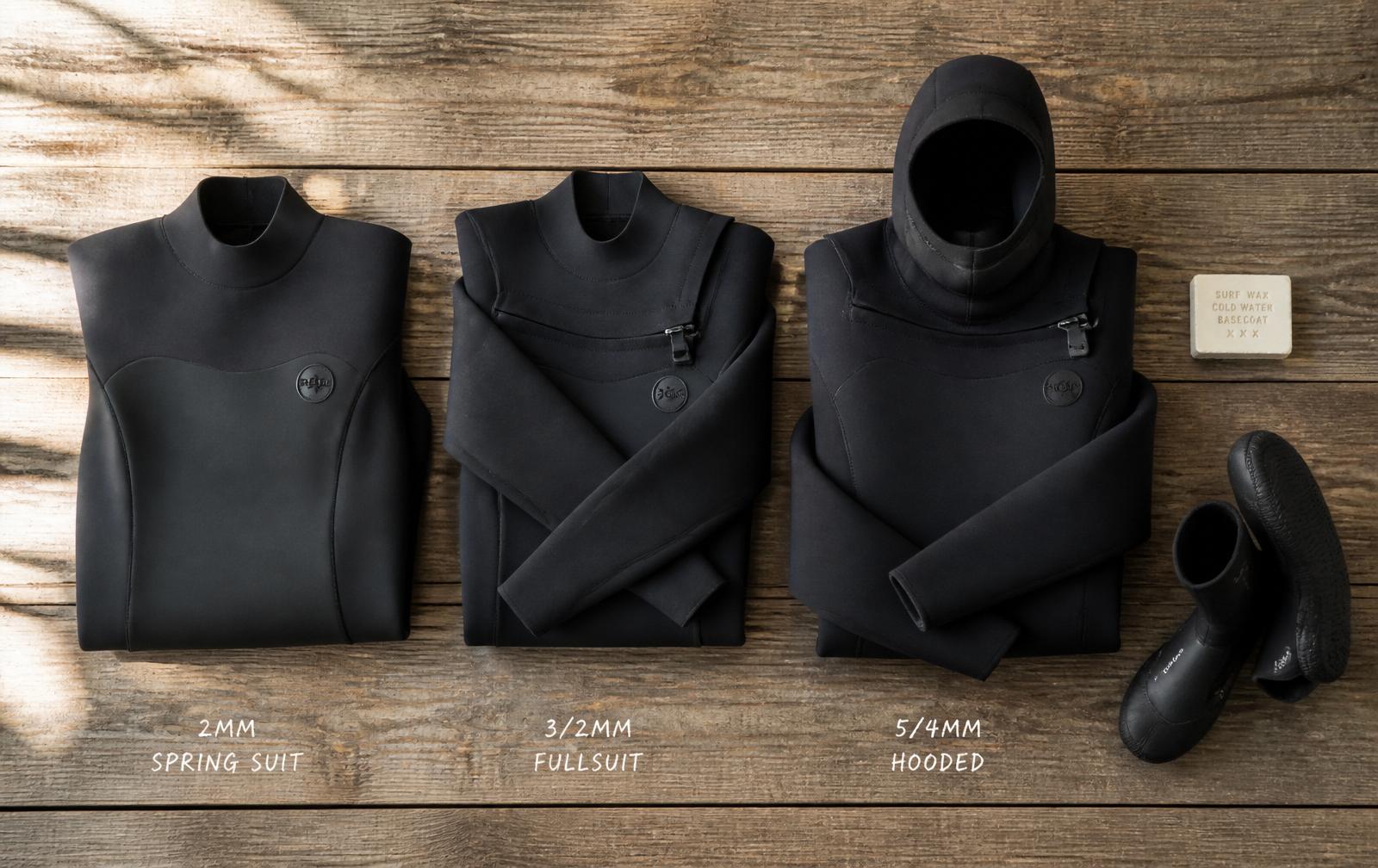
Across four independent brand-editorial charts, the consensus is tight: a 3/2 mm full suit is the most versatile single wetsuit you can own for temperate water (15–20 °C). Step up one mm of torso neoprene for every 3 °C the water drops, and add a hood below 12 °C.
How wetsuit thickness actually works
Neoprene doesn't insulate directly — it traps a thin layer of water against your skin that your body warms to a stable temperature. Thicker neoprene traps a bigger buffer and resists compression at depth, which is why 5 mm suits stay warm 60 minutes into a session while 2 mm suits feel chilly at 45.
The two numbers on a suit ("4/3", "5/4") are torso and limb thickness. Brands split the neoprene because your core wants heat and your arms want flexibility — a 4/3 breathes better than a 4/4 without sacrificing much warmth.
Reading the temperature chart
The four charts we aggregated (Rip Curl, Billabong, Quiksilver, Vissla) agree within one thickness step across the entire range. Where they differ is wind and session length: a 15 °C morning in a 20 kn offshore feels closer to 12 °C, so bump one step up. Multi-hour sessions also push you up a step regardless of air.
Common mistakes
- Buying for average water temp instead of your coldest three months.
- Skipping the hood between 9 and 12 °C — you'll lose 20 minutes of session tolerance.
- Sizing up for comfort. A loose suit flushes cold water on every duck-dive.
- Stacking a rash vest under a 3/2 in summer — the trapped air makes you colder, not warmer.
Which suit for which band
Once you have your target thickness, pick the suit reviewers rate for that band. In the 15–18 °C mainstream — where most surfers spend the year — the Rip Curl Dawn Patrol 3/2 is the value pick, and the Flashbomb 3/2 and O'Neill Hyperfreak 3/2 are the two most-praised premium options. Step down to 12–15 °C and the O'Neill Epic 4/3 gives the best warmth-per-dollar. For cold-water surfers below 12 °C, the Flashbomb Heatseeker 5/4 Hooded is the consensus benchmark.
What the experts say
| Source | Score | Key takeaway |
|---|---|---|
| Rip Curl — Wetsuit Temperature & Thickness Guide | 9.4 / 10 | "There's no single perfect number — wind, session length and personal cold tolerance shift the answer up or down one thickness step." |
| Billabong — Wetsuit Thickness & Temperature Guide | 9.2 / 10 | "For most surfers a 3/2 mm full suit is the widest-use wetsuit you can own — it covers 15–20 °C water year-round in temperate climates." |
| Quiksilver — The Ultimate Wetsuit Thickness Guide | 9.0 / 10 | "Below 12 °C, hooded 5/4 mm suits stop being optional. Above 21 °C, a 2 mm spring or top is plenty." |
| Vissla — Wetsuit Thickness & Temperature Chart | 8.8 / 10 | "The first number is the torso, the second is the arms and legs. More torso mm keeps your core warm without stiffening paddling." |
Top-rated suits by temperature band
Average across the five most-cited suits in this guide: $431 ($249–$699).
| Suit | Best band | Price | |
|---|---|---|---|
| Rip Curl Dawn Patrol 3/2 | 15–18 °C | $249 | Read review |
| O'Neill Epic 4/3 | 12–15 °C | $279 | Read review |
| O'Neill Hyperfreak 3/2 | 15–18 °C | $429 | Read review |
| Rip Curl Flashbomb 3/2 | 15–18 °C | $499 | Read review |
| Rip Curl Flashbomb Heatseeker 5/4 Hooded | 9–12 °C | $699 | Read review |
Video guides


Related reading
FAQ
What wetsuit thickness do I need for cold water?
Below 12 °C (54 °F), all four editorial sources we surveyed recommend a 5/4 mm hooded full suit paired with 5 mm booties and 3 mm gloves. Between 9 and 12 °C the hood becomes non-negotiable — bare-headed sessions cost roughly 20 minutes of tolerance.
What do the numbers on a wetsuit mean?
The first number is the neoprene thickness (in mm) around the torso; the second is the arms and legs. A 4/3 has 4 mm on the chest and back for warmth and 3 mm on the limbs for paddling flexibility. Some cold-water suits add a third number for the arms (e.g. 5/4/3).
Is a 3/2 or 4/3 wetsuit more versatile?
A 3/2 is the widest-use suit you can own if you surf temperate climates (roughly 15–20 °C). A 4/3 buys you another 3 °C of tolerance down to about 12 °C but is warmer than you need in summer. If you can only own one, pick the thickness that matches your coldest three months.
Do I need a hooded wetsuit?
Consensus across Rip Curl, Quiksilver and Vissla: yes below 12 °C, optional 12–14 °C, and no above 14 °C. An attached hood traps flushed water at the neckline better than a separate cap.
How much should a good wetsuit cost?
Across the five most-recommended suits in this guide, prices range from $249 to $699, averaging $431. Entry-level 3/2s start around $200; premium high-stretch suits and hooded 5/4s reach $700.
How long does a surf wetsuit last?
With regular use (3–4 sessions/week) and freshwater rinses, a mid-range suit lasts 2–3 seasons before neoprene compression and seam wear reduce warmth. Premium suits with taped seams typically hit 3–4 seasons.
Aggregated from 4 independent editorial sources and 2 video guides. Average suit price $431.