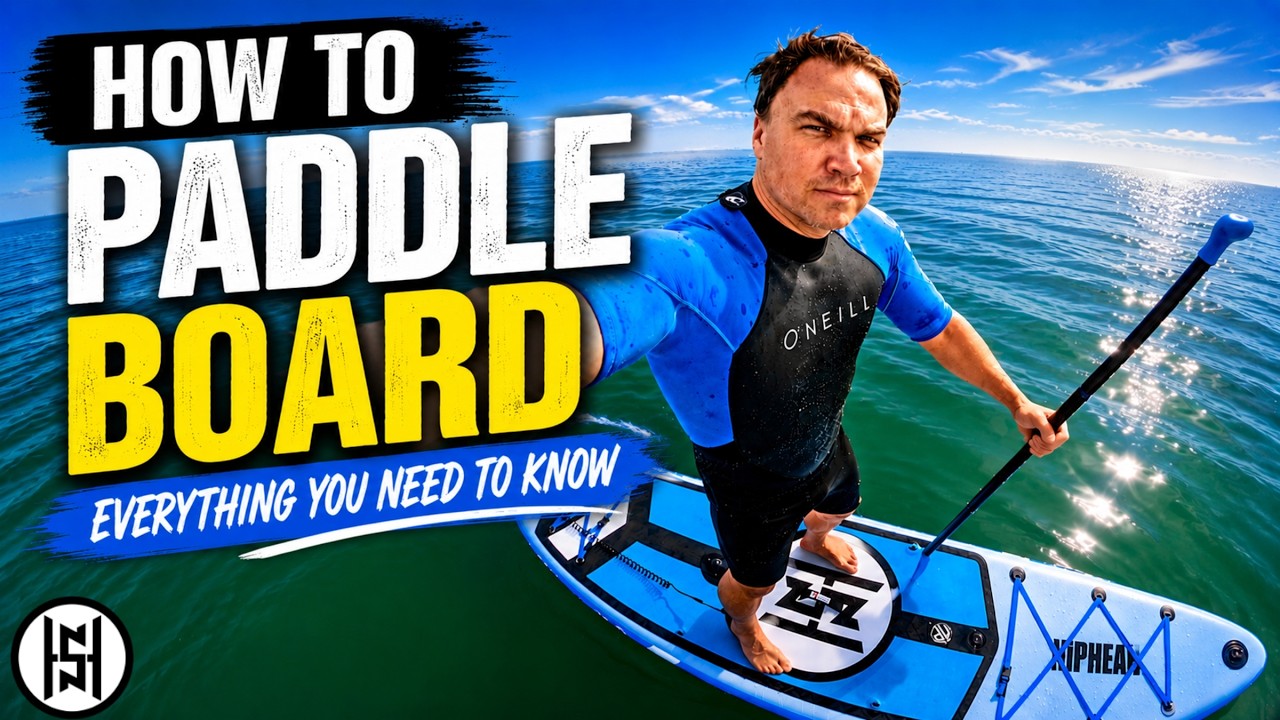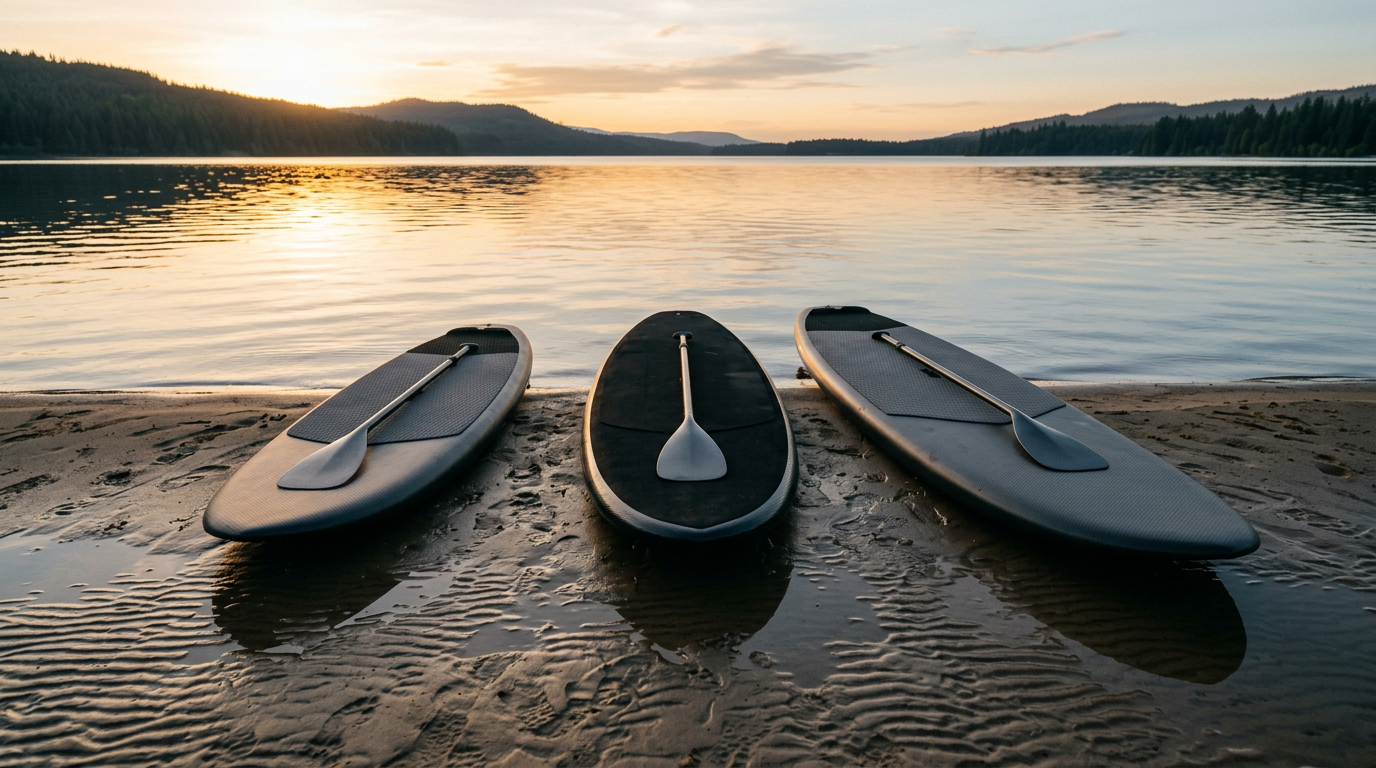
Most paddle boards that end up unused in a garage were bought on price and length alone. Those two numbers say almost nothing about whether a board will hold you steady on a windy afternoon, fit in your car, or track straight across a bay. The specs that decide that are width, volume, weight capacity and hull shape, and every serious manufacturer publishes them.
This guide pulls the published size charts and manufacturer specs into one place, so you can work from your body weight and your local water to a shortlist. It covers board type by use, sizing by weight, inflatable against hard construction, paddle length, and the small pieces of kit that change a session more than an extra foot of board ever will. Where a spec came from a source, that source is linked.
Start with what you will paddle on
Board shape follows water. Flat lakes and sheltered estuaries reward a wide all-round board that stays calm underfoot. Open coast and long crossings reward a longer touring hull that holds a line between strokes. Waves reward something short enough to turn.
Pick the water you paddle most weekends, not the trip you might take next year. A board tuned for the common case gets used.
| Board type | Typical length | Best for |
|---|---|---|
| All-round inflatable | 10'0" – 11'0" | First board, mixed flat water and small chop, households short on storage |
| Touring | 11'6" – 12'6" | Distance paddling, tracking in a straight line, loaded day trips |
| Race | 12'6" – 14'0" | Speed and glide once your balance is settled, narrow rails, low volume margins |
| SUP surf | 7'6" – 9'6" | Catching waves, tighter turns, riders already comfortable standing in moving water |
Size by weight, then check capacity
The size chart published by Surfer Today maps rider weight to length and width for both surf and all-round shapes. Width does most of the stability work: an extra two inches across the middle is felt immediately, while an extra six inches of length mostly changes glide.
| Rider weight | SUP surf | All-round |
|---|---|---|
| Under 57 kg / 125 lb | 9'0" – 10'6", 26" – 26.5" wide | 9'6" – 10'6", 27" – 28" wide |
| 57 – 68 kg / 125 – 150 lb | 10'6" – 11'0", 27" – 27.5" wide | 11'0", 28" – 29" wide |
| 68 – 82 kg / 150 – 180 lb | 10'0" – 11'0", 28" – 28.5" wide | 11'0" – 11'6", 29.5" – 30.5" wide |
| 82 – 95 kg / 180 – 210 lb | 11'0" – 11'6", 29.5" – 31.5" wide | 11'6" – 12'0", 32" – 33" wide |
| 95 kg+ / 210 lb+ | 12'0", 32" wide | 12'0", 33" wide |
Dimensions alone still miss one thing. Volume in litres is what actually floats you, as Alpkit's sizing explainer sets out. A practical starting ratio for a stable board is body weight in kilograms times 1.5 to 2. Then read the manufacturer's stated weight capacity and subtract everything you carry, including a dog, a cooler or a child.
Inflatable or hard board
Inflatables have taken over the entry and family market for practical reasons. They roll into a backpack, survive being dropped on concrete, and store in a cupboard. Modern drop-stitch construction at high pressure is stiff enough that most paddlers never feel the difference on flat water. The Red Paddle Co Ride 10'6 MSL is the reference point in that class, scoring
Hard boards keep the advantage where stiffness and waterline shape matter most: racing, downwind runs and surf. They are also less forgiving of a rocky launch and a small garage. Brands like Starboard and Fanatic publish both, and their spec sheets list volume and capacity side by side so you can compare directly.
Getting the paddle right
A paddle that is too short forces you to bend at the waist and drains your lower back. Too long and you cannot get the blade fully buried. Set length from your standing height and the discipline.
| Use | Paddle length |
|---|---|
| SUP surfing | Height plus 15 – 20 cm (6 – 8 in) |
| All-round cruising | Height plus 20 – 25 cm (8 – 10 in) |
| Touring and racing | Height plus 25 – 30 cm (10 – 12 in) |
Shaft material changes the feel more than the price tag suggests. Aluminium is heavy and cold, fibreglass is the sensible middle, and carbon is light and stiff. Starboard's shaft flex explainer, linked in the video section, is a useful listen before spending on carbon.
The accessories that matter
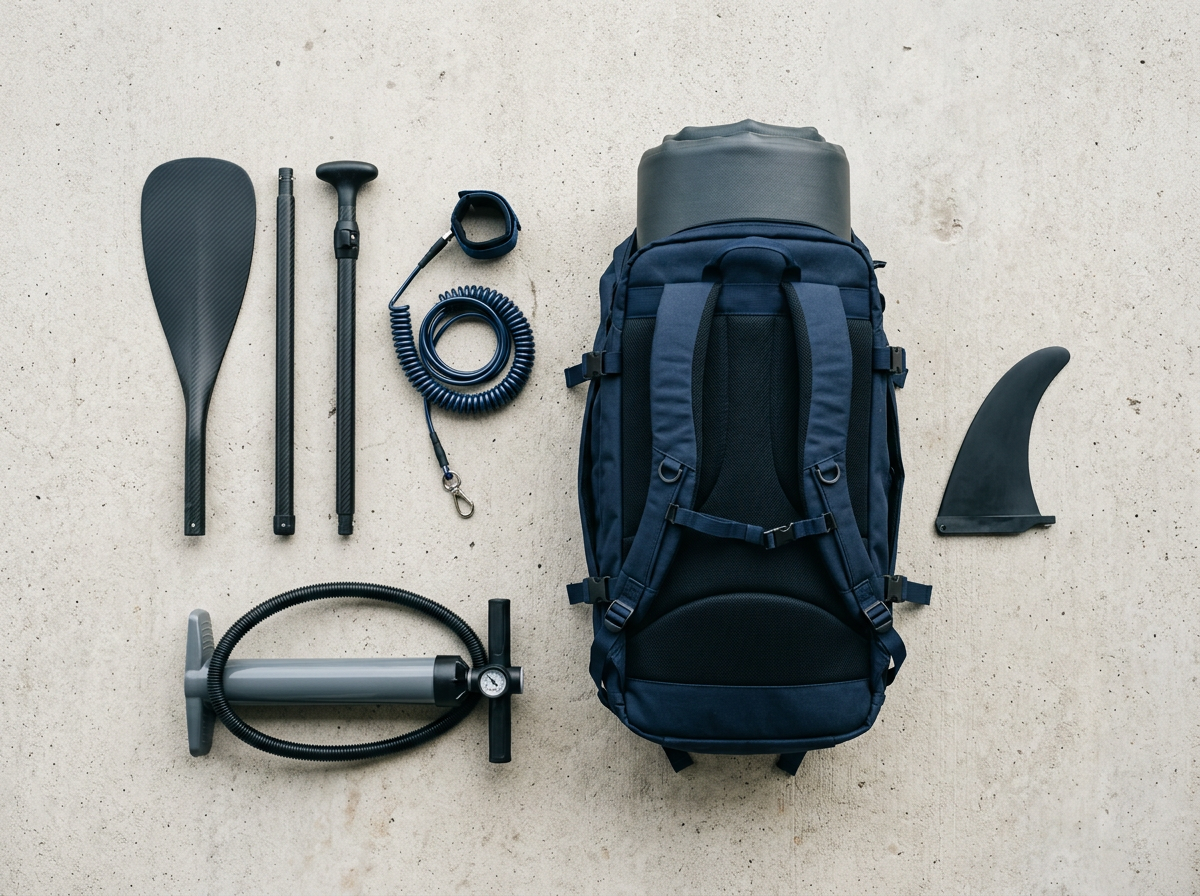
- A leash matched to the water. Coiled ankle for flat water and sea, quick-release waist belt for rivers and tidal flow, per Paddle UK guidance.
- A buoyancy aid. It is the piece most often skipped and the one that changes outcomes.
- A pressure-gauged pump, or an electric one if you paddle several times a week. Underinflated boards sag and feel unstable.
- A spare fin and the fin screw. Losing the centre fin ends a session instantly.
- A dry bag clipped to the front bungees for phone, keys and a warm layer.
Where cheap boards cut corners
Price differences on inflatables come down to drop-stitch density, seam construction and the pressure the board is rated to hold. A board rated to 15 psi from a known brand behaves differently under a heavy paddler than a bargain board rated to 10 psi that struggles to reach it. That gap is what Greyson Roberts' teardown of budget boards documents.
If budget is tight, a used board from an established brand almost always outperforms a new unbranded one. Check for seam separation, a soft middle when fully inflated, and whether the valve holds pressure overnight.
A shortlist you can act on
Work in this order: choose your water, read the size chart row for your weight, confirm the volume and capacity figures on the manufacturer's spec page, then set the paddle length. Compare the boards on our paddleboard reviews index once you know the numbers you need. If waves are the goal rather than flat water, the sizing logic in our surfboard volume guide carries over closely, and the wing foil gear guide covers the next step for anyone tempted by foiling.