Surfboard Fins Guide
Pick the right fins for your board, weight and waves. This guide aggregates the fin selection playbooks published by Eveley Surf, Surf Station and Eisbach Riders, plus the physics breakdown from Surf Simply — then maps each recommendation to the specific fins we track across the Surfex fin review index.
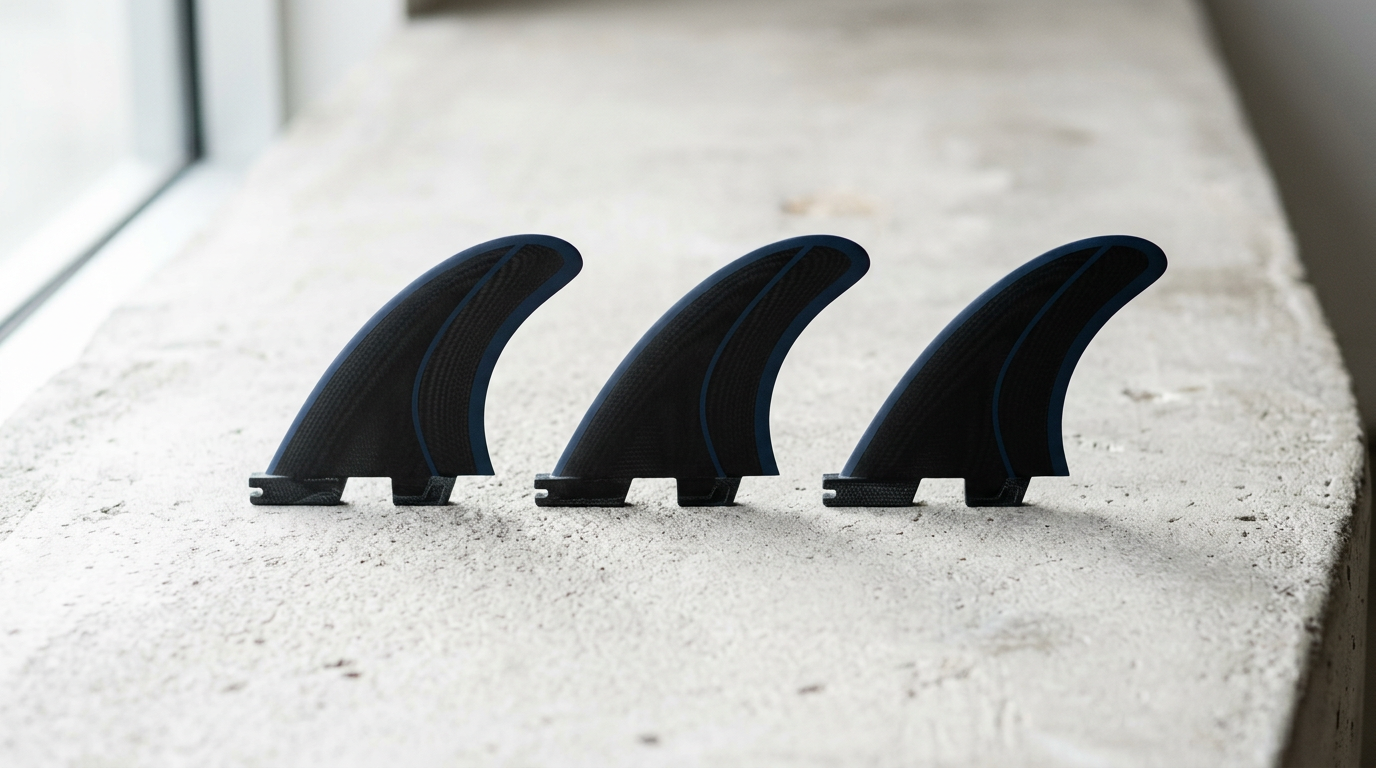
Original Surfex illustration.
Surfex aggregates fin sizing charts and setup guides from Eveley Surf, Surf Station and Eisbach Riders. No sponsored placement; every claim links to its original source.
Across four independent guides, the consensus is tight: start with a thruster, size fins by rider weight (not board size), and pick your fin system by whichever boxes are already glassed into your board. Template details — base, rake, foil — matter most once your surfing outpaces the stock fins.
Size first, template second
Every guide we aggregated leads with the same first filter: match the fin size to your body weight, not to the length of the board. FCS and Futures publish nearly identical bands, so the size chart above works across brands. Get the size right and a stock template will already surf 80% of the way to your ceiling.
Board size only matters when it's dramatically different. Riding a step-up in solid, overhead surf? Bump one size up for extra hold. Sliding a fish in weak, waist-high waves at the same weight? Stay at your normal size — a smaller fin loses too much drive.
Choose your setup by wave, not by trend
Thrusters remain the default for a reason: they balance drive and release across almost every wave type. Quads pull ahead once the wave gets hollow or fast — that's why fishes and grovellers so often ship with quad boxes. Twins are a specialist choice for retro fishes in soft waves. 2+1 lives on mid-lengths and longboards. If you own one shortboard, keep a thruster set as the daily driver and add a quad set only if you also ride a fish.
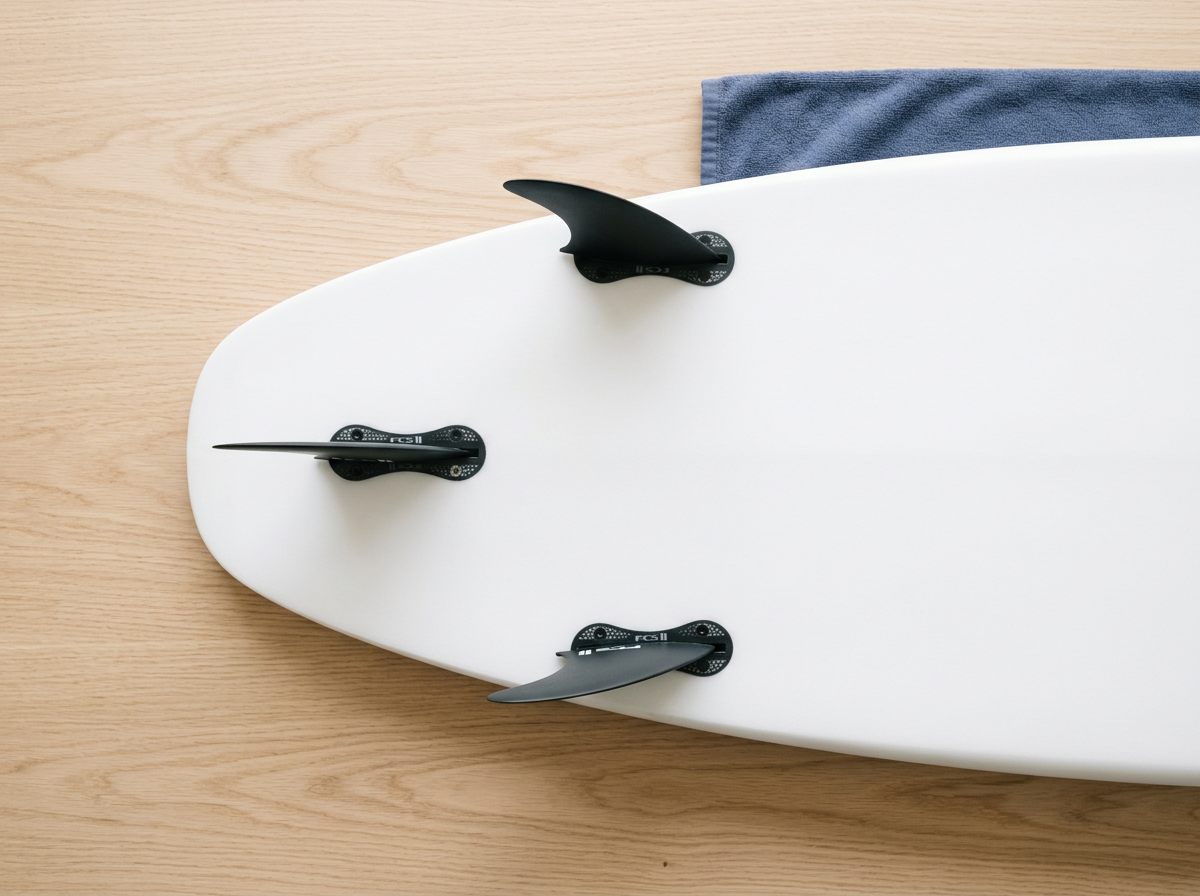
FCS vs Futures — the honest answer
The functional gap is small. Both systems are strong, both have a full spectrum of templates, and both are supported by every major shaper. FCS II wins on swap speed — no screw, in and out in seconds. Futures wins on a marginally stiffer feel under load, thanks to its single-screw design. The real filter is which boxes are glassed into the board you already own; you can't switch systems without a shaper.
Reading a template: base, rake, foil
Once the size and system are locked, template is where you tune feel. Base is the fin's width at the board — more base means more drive down the line. Rake (or sweep) is how far the tip leans back — more rake draws turns out, less rake tightens them. Foil is the cross-section: flat-inside side fins push drive, symmetric foils feel neutral. A "drivey" fin usually has a wide base with moderate rake; a "loose" fin has less base and less rake.
Common mistakes
- Sizing fins by board length instead of body weight.
- Chasing a pro's signature template when the stock fin still isn't dialled.
- Skipping the centre fin on a thruster to "loosen it up" — you kill the drive too.
- Buying premium carbon fins on an entry board — the board caps the return before the fin does.
How much to spend
Entry composite sets ($40–$70) are perfectly usable and where most first-time buyers should land. Mid-tier performance-core sets ($80–$130) are the sweet spot for intermediates and up. Premium carbon or pro-signature sets ($140–$220) only earn their price once your surfing genuinely outpaces the mid-tier — a fact most editorial guides make explicit. Browse the full fin review index to see how specific templates rate across sources.
| Tier | Price range (USD) |
|---|---|
| Entry (plastic/composite) | $40 – $70 |
| Mid (performance core) | $80 – $130 |
| Premium (carbon / signature) | $140 – $220 |
What the experts say
| Source | Score | Key takeaway |
|---|---|---|
| Eveley Surf — Complete Fin Setup Guide | 9.2 / 10 | "Fins are the final control system that decides how a board feels. Same shape, different fins, completely different ride." |
| Eveley Surf — Advanced Fin Buyer's Guide | 9.0 / 10 | "Base drives, rake controls arc, foil governs release. Read a template as three variables, not one shape." |
| Surf Station — How to Choose Surfboard Fins | 8.8 / 10 | "Rider weight is the first filter. Size the fin to the surfer before you argue about template or brand." |
| Eisbach Riders — FCS vs Futures vs US Box | 8.6 / 10 | "FCS II installs without a screw and swaps in seconds; Futures runs one screw per fin and feels marginally stiffer under load." |
Video guides


Related reading
FAQ
What size surfboard fin do I need?
Fin size is set by rider weight, not board size. XS fits under 55 kg, S fits 55–70 kg, M fits 65–80 kg (the widest overlap band), L fits 75–90 kg, and XL is for surfers 85 kg and up. FCS and Futures publish nearly identical bands, so weight is a reliable first filter across brands.
Thruster vs quad — which is better?
Thrusters are the industry default because they balance drive and release across most waves. Quads are faster and looser in hollow or fast waves and pair naturally with fish outlines. Keep a thruster set as your daily driver; add a quad set if you surf a fish or mainly ride hollow, small-to-average waves.
FCS II vs Futures — is there a real difference?
The performance difference in the water is small. FCS II installs without a screw, so swapping mid-session is faster. Futures uses a single screw per fin, which many reviewers feel gives a slightly stiffer connection under load. The main practical filter is the fin boxes already glassed into your board — you can't switch systems without a shaper.
What do fin template terms like base, rake and foil actually mean?
Base is the width where the fin meets the board and drives forward projection. Depth is how far the fin drops, which controls hold. Rake (or sweep) is how far the tip leans back — more rake draws turns out, less rake tightens them. Foil is the fin's cross-section: flat-inside side fins add drive, symmetric foils feel neutral.
How much should I spend on surfboard fins?
Entry composite sets run $40–$70 and cover the basics. Mid-range performance-core sets ($80–$130) are where most surfers land. Premium carbon or pro-signature sets sit at $140–$220 and are meaningful only once your surfing outpaces the mid-tier fin.
Can I use the same fin size across all my boards?
Yes, if the boards are similar volume and the same fin system. Fin size is set by rider weight first; board size only matters when it's dramatically different (a step-up in overhead surf often takes one size larger for extra hold).
Aggregated from 4 independent editorial sources and 3 video guides.